Skip to content
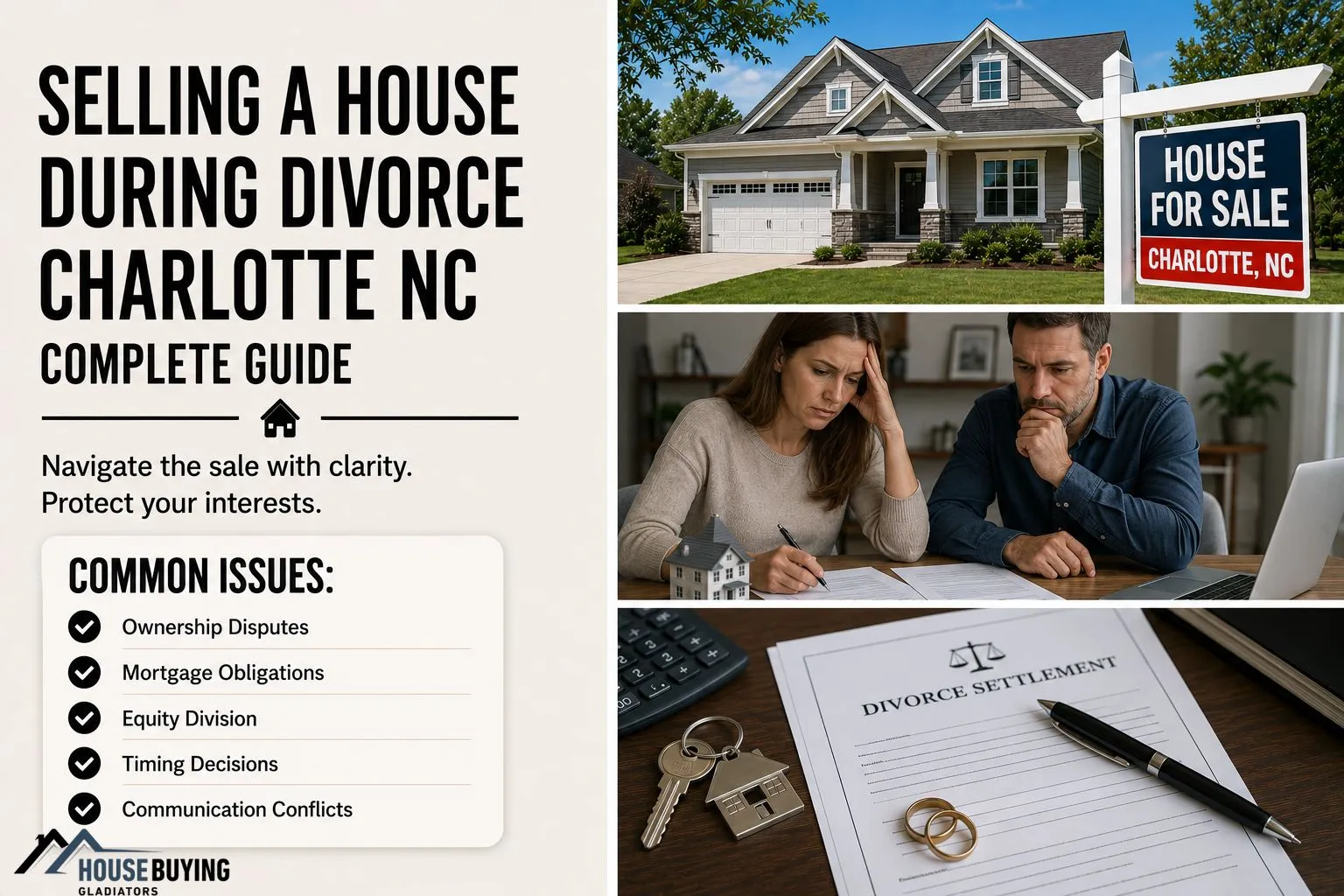
Selling a house during divorce in Charlotte, NC is possible before, during, or after the divorce process, but the right approach depends on who legally owns the property, whether both spouses agree to sell, and how the home’s equity will be divided. Understanding these factors early can prevent delays, reduce conflict, and protect your financial interests.
What Selling A House During Divorce Really Involves
A divorce home sale is more than a typical real estate transaction. Along with preparing the property for sale, spouses often need to address ownership rights, mortgage obligations, equity distribution, and the timing of the sale. These decisions can directly affect both the divorce process and each person’s financial outcome.
For homeowners in Charlotte and throughout Mecklenburg County, market conditions may also influence whether selling immediately, waiting, or negotiating a buyout is the better choice. Every situation is unique, making it important to evaluate your options before making major decisions.
Before Selling A House During Divorce In Charlotte, NC
Ask yourself these questions first:
- Do both spouses legally own the home?
- Is there agreement on selling the property?
- Is there enough equity after paying off the mortgage and selling costs?
- Can one spouse afford to keep the home?
- Will selling now simplify the divorce settlement?
Answering these questions early often leads to a smoother transaction and fewer disputes later.
Practical Insight
One of the biggest mistakes divorcing homeowners make is focusing only on the home’s market value. The amount you actually receive depends on mortgage balances, selling expenses, taxes, and how the equity is divided. Looking at the complete financial picture before listing the property often leads to better decisions for both parties.
If you’re exploring alternatives before making a decision, our guide to selling your house as-is in Charlotte explains when skipping repairs may be the most practical and cost-effective option.
Can You Sell A House During Divorce In Charlotte, NC?
Yes, you can sell a house during divorce in Charlotte, NC, but whether you can move forward depends on who owns the property, whether both spouses agree to the sale, and the terms of the divorce. In many cases, both spouses must cooperate before the transaction can be completed.
When Can You Sell A House During Divorce In Charlotte, NC?
The timing of the sale often falls into one of these situations:
| Timing | What It Means |
|---|---|
| Before filing for divorce | Couples mutually decide to sell before legal proceedings begin. |
| During the divorce | The home is sold while the divorce is pending, often by agreement or court direction. |
| After the divorce is finalized | The divorce agreement determines when and how the property will be sold. |
The best option depends on your financial situation, living arrangements, and the terms of your divorce.
What If One Spouse Doesn’t Want To Sell The House?
Disagreements over the family home are common. If one spouse wants to sell and the other wants to keep the property, factors such as legal ownership, mortgage responsibility, affordability, and any court orders may determine the outcome. Resolving these issues early can help avoid unnecessary delays and additional legal expenses.
Charlotte Example
A couple in Charlotte decides to divorce but still owns a home together. One spouse wants to move quickly, while the other hopes to keep the property. Instead of immediately listing the home, they first determine the available equity, review the mortgage, and decide whether a buyout or sale best meets both of their financial goals.
Key Takeaway
Selling a house during divorce isn’t just about finding a buyer it’s about coordinating the sale with the legal and financial decisions surrounding the divorce. Understanding when you can sell and what approvals may be needed helps reduce conflict and creates a smoother path toward closing.
If you’re looking for the quickest way to complete the sale, our guide to selling a house fast in Charlotte explains the options available and what to expect from each selling method.
What Happens To Your Mortgage When Selling A House During Divorce In Charlotte, NC?
A mortgage doesn’t disappear because of a divorce. If both spouses signed the loan, they generally remain responsible for it until it’s paid off, refinanced, or the home is sold. At the same time, any equity in the property typically becomes an important financial asset that must be addressed during the divorce.
Mortgage And Equity When Selling A House During Divorce
Many homeowners confuse these two terms, but they affect your finances in different ways.
| Mortgage | Home Equity |
|---|---|
| The amount still owed to the lender | The portion of the home’s value you own |
| Monthly loan payments continue until the loan is resolved | Equity may be divided as part of the divorce settlement |
| Remains tied to the borrowers on the loan | Changes as home values and loan balances change |
Understanding both numbers gives you a clearer picture of your available options.
Three Ways To Handle A House During Divorce In Charlotte, NC
Rather than following one path, most divorcing couples choose one of these approaches:
Sell the home
- Pay off the mortgage.
- Cover selling costs.
- Divide the remaining proceeds according to the divorce agreement.
One spouse keeps the home
- The remaining spouse may refinance the mortgage into their own name, if possible.
- The other spouse may receive compensation for their share of the equity.
Delay the sale
- Some couples temporarily keep the home for financial or family reasons before selling later.
- This approach requires clear agreements on mortgage payments, maintenance, and other ongoing expenses.
A Cost Many Couples Don’t Expect
Even if you’re living separately, the home continues to generate expenses. Mortgage payments, property taxes, insurance, utilities, HOA dues, and maintenance don’t stop during the divorce. The longer decisions are delayed, the more these carrying costs can reduce the equity available to both spouses.
Key Takeaway
Before deciding whether to sell or keep the property, calculate both the remaining mortgage balance and the home’s estimated equity. Looking beyond the home’s market value helps you understand the true financial impact of each option.
If you’re unsure how much money you may receive after selling, our guide to calculating net proceeds from a home sale in Charlotte explains the costs that affect your final payout.
Your Options For Selling A House During Divorce In Charlotte, NC
There isn’t one “best” way to handle a house during divorce. The right option depends on your financial situation, ability to cooperate, and long-term goals. Understanding the advantages and trade-offs of each choice helps you make a more informed decision.
Understanding common mistakes when selling a home during divorce can help couples avoid unnecessary delays, financial setbacks, and emotional decisions that could complicate both the home sale and the divorce process.
Compare Your Options For Selling A House During Divorce
| Option | Best When | Things To Consider |
|---|---|---|
| Sell the home | Neither spouse wants to keep the property | Equity can be divided after paying eligible expenses. |
| One spouse buys out the other | One spouse wants to remain in the home | The remaining spouse must usually qualify to handle the mortgage and ongoing costs. |
| Continue co-owning temporarily | Selling immediately isn’t practical | Requires clear agreements on payments, maintenance, and future plans. |
There is no universal solution. The best choice is the one that fits both your financial reality and your divorce agreement.
How To Choose The Best Option For Selling A House During Divorce
Before making a decision, consider:
- Can one spouse comfortably afford the home alone?
- How much equity is available?
- Are both spouses willing to cooperate?
- Will keeping the home create financial strain?
- Does selling provide a cleaner financial separation?
Answering these questions often makes the decision much clearer.
Common Mistake To Avoid
Many couples focus on who gets the house instead of whether keeping it is financially sustainable. A home can become a burden if mortgage payments, maintenance, taxes, and insurance exceed what one person can reasonably afford after the divorce.
Charlotte Example
A couple in Mecklenburg County initially planned for one spouse to keep the family home. After reviewing monthly housing costs and future expenses, they realized selling the property would leave both parties in a stronger financial position and allow each to move forward without ongoing shared responsibilities.
Key Takeaway
The best outcome isn’t always keeping the home it’s choosing the option that supports your financial stability after the divorce. Carefully comparing your choices before making a commitment can help prevent costly decisions you’ll have to revisit later.
If you’re considering selling instead of keeping the property, our guide to cash home buyers in Charlotte explains how a direct sale can simplify the process and reduce the time needed to close.
How Long Does Selling A House During Divorce In Charlotte, NC Take?
The timeline for selling a house during divorce in Charlotte, NC varies based on cooperation between spouses, the home’s condition, buyer financing, and the local market. While some sales close within a few weeks, others take several months if legal or financial issues delay the process.
What Can Delay Selling A House During Divorce?
Even in a strong housing market, these issues commonly extend the timeline:
- One spouse delays signing documents.
- Disagreements over the listing price.
- Title or ownership questions.
- Waiting for divorce-related decisions.
- Buyer financing falls through.
- Repairs requested after inspections.
Many delays have little to do with the real estate market they stem from unresolved decisions between the parties.
Timeline Comparison
| Selling Method | Typical Timeline | Best For |
|---|---|---|
| Traditional Listing | Longer | Homes in excellent condition where maximizing price is the priority |
| Cash Home Sale | Shorter | Couples who want a faster, more predictable closing |
The right choice depends on your goals, not just how quickly you want to sell.
Reduce Delays Before Listing
Preparing early can make a significant difference.
- Gather mortgage and ownership documents.
- Agree on the asking price.
- Decide how sale proceeds will be handled.
- Resolve any major disagreements before marketing the property.
- Choose a selling strategy that matches your timeline.
These steps often prevent avoidable setbacks once an offer is received.
A Better Way To Evaluate Your Timeline
Instead of asking, “How fast can we sell?”, ask:
“What is preventing us from closing sooner?”
Identifying the biggest obstacle whether it’s paperwork, repairs, financing, or communication usually has a greater impact on the closing date than the selling method itself.
Key Takeaway
A smooth divorce sale depends more on preparation and cooperation than market speed. The earlier both parties address legal, financial, and logistical issues, the easier it becomes to complete the sale and move forward.
If you’re comparing whether selling directly or listing with an agent better fits your situation, our comparison of cash home buyers and real estate agents in Charlotte explains the differences in cost, timing, and overall selling experience.
Why Homeowners Selling A House During Divorce In Charlotte, NC Choose A Direct Sale
For many couples going through a divorce, certainty matters just as much as price. A direct home sale can eliminate many of the delays associated with traditional listings, making it a practical option for homeowners who want to resolve the property quickly and move forward.
Why A Traditional Sale Can Become Complicated
Selling through the open market often requires ongoing cooperation between both spouses. Even small disagreements can delay the transaction.
Common challenges include:
- Coordinating showings while living separately.
- Deciding who pays for repairs.
- Negotiating inspection requests.
- Waiting for buyer financing approval.
- Managing multiple offers together.
When communication is already difficult, these steps can add unnecessary stress.
When A Direct Sale Makes Sense
A direct home sale is often worth considering if:
- ✓ You want to avoid making repairs.
- ✓ The property is vacant or needs updates.
- ✓ You want to avoid months of showings.
- ✓ You’re looking for a more predictable closing date.
- ✓ Both spouses prefer to divide the proceeds and move on.
It isn’t the right solution for every homeowner, but it can simplify the process in many divorce situations.
Compare The Two Approaches
| Consideration | Traditional Listing | Direct Cash Sale |
|---|---|---|
| Repairs | Often recommended | Usually not required |
| Showings | Multiple | None |
| Buyer Financing | Required in many sales | Not typically needed |
| Closing Timeline | Less predictable | More flexible |
| Overall Process | More steps | Simpler transaction |
The best choice depends on your priorities rather than one option being universally better.
Think Beyond The Sale Price
Many homeowners compare offers without considering the total cost of selling. A slightly higher purchase price may not result in more money if you’re paying for repairs, additional mortgage payments, utilities, insurance, and other holding costs while waiting to close.
Looking at the overall financial outcome often provides a clearer basis for making a decision.
Key Takeaway
The best selling method is the one that helps both spouses reach a fair resolution with the least amount of financial risk and unnecessary stress. Whether you choose a traditional listing or a direct sale, understanding the complete picture before making a decision can help you move through the divorce process more confidently.
If financial pressure is also influencing your decision to sell, our guide to avoiding foreclosure in Charlotte explains the options available before the situation becomes more difficult.
Why Homeowners Selling A House During Divorce In Charlotte, NC Choose House Buying Gladiators
Selling a house during a divorce requires more than finding a buyer it requires a process that is straightforward, flexible, and respectful of both parties. House Buying Gladiators helps Charlotte homeowners navigate real estate challenges by offering a simple selling experience without unnecessary complications.
What Makes Our Process Different?
Instead of asking homeowners to prepare the property for months, we focus on making the transaction as efficient as possible.
With House Buying Gladiators, you can:
- Sell your house in its current condition.
- Skip repairs and renovations.
- Avoid agent commissions.
- Receive a fair, no-obligation cash offer.
- Choose a closing date that works for your situation.
- Sell vacant, inherited, or occupied homes.
Our goal is to reduce the stress of selling so you can focus on the next chapter.
Designed For Real-Life Divorce Situations
We regularly work with homeowners who are facing situations such as:
- One spouse has already moved out.
- The property needs repairs before listing.
- Both spouses want to avoid lengthy negotiations.
- The home has become a financial burden.
- The divorce settlement requires the property to be sold.
Every situation is different, which is why we tailor the process to your specific needs instead of offering a one-size-fits-all solution.
What Homeowners Often Value Most
When speaking with divorcing homeowners, these priorities come up repeatedly:
| Priority | Why It Matters |
|---|---|
| Simplicity | Fewer decisions and less paperwork can reduce stress. |
| Flexibility | Closing dates can align with your divorce timeline. |
| Transparency | Knowing what to expect helps both parties plan ahead. |
| Convenience | Selling as-is eliminates the need for repairs and staging. |
These factors can be just as important as the purchase price when emotions and timelines are involved.
Before You Accept Any Offer
Whether you sell to House Buying Gladiators or another buyer, make sure you understand:
- Your estimated net proceeds.
- Any remaining mortgage balance.
- Closing costs and other selling expenses.
- How the sale fits into your divorce agreement.
- The timeline for receiving your funds.
Taking time to review these details helps prevent unexpected financial surprises after closing.
Key Takeaway
The right buyer should make the selling process easier not more complicated. If you’re selling a house during divorce in Charlotte, choosing a buyer who offers transparency, flexibility, and a straightforward closing process can help both parties move forward with greater confidence.
FAQS About Selling A House During Divorce In Charlotte, NC
Yes. You can sell a house before, during, or after a divorce, provided the sale complies with your ownership rights and any applicable court orders or divorce agreements.
If both spouses own the property, they generally need to cooperate to complete the sale. If there is a disagreement, the outcome may depend on the divorce proceedings and any court decisions.
The proceeds are not automatically split 50/50. After the mortgage and selling expenses are paid, the remaining equity is divided according to the divorce settlement or applicable North Carolina law.
Yes. One spouse may keep the home if they can reach an agreement with the other spouse and meet any financial or legal requirements, such as refinancing the mortgage if necessary.
A disagreement doesn’t always prevent a sale, but it can delay the process. The resolution often depends on ownership, the divorce agreement, and any court orders affecting the property.
There isn’t a single answer. Some couples benefit from selling before the divorce is finalized, while others wait until the settlement determines how the property will be handled. The best timing depends on your financial and legal circumstances.
Yes. Many homeowners choose to sell their property as-is, especially when they want to avoid investing additional time or money during the divorce process.
The timeline varies based on the local market, the property’s condition, buyer demand, financing, and how quickly both spouses can make decisions and complete the required paperwork.
Selling the property itself does not typically harm your credit. However, missed mortgage payments, loan defaults, or foreclosure during the divorce can negatively affect your credit history.
Many homeowners choose House Buying Gladiators because they want to sell their house as-is, avoid repairs and commissions, receive a fair cash offer, and choose a closing date that works with their divorce timeline.
Final Thoughts On Selling A House During Divorce In Charlotte, NC
Selling a house during divorce in Charlotte, NC doesn’t have to become another source of conflict. The best outcomes usually happen when homeowners understand their options early, communicate clearly, and choose a selling strategy that fits both their financial situation and long-term goals.
Remember These Key Points
Instead of trying to solve every issue at once, focus on the decisions that have the greatest impact:
- Confirm who has the authority to sell.
- Understand the home’s equity and remaining mortgage.
- Compare all available selling options.
- Estimate the true cost of keeping the property.
- Choose a timeline that supports your divorce process.
Making these decisions early often reduces stress, unexpected costs, and unnecessary delays.
There Isn’t A One-Size-Fits-All Solution
Every divorce is different. The right decision for one couple may not be the best choice for another.
Your ideal approach depends on factors such as:
- Whether one spouse wants to keep the home.
- The amount of available equity.
- The property’s condition.
- Your financial obligations after divorce.
- How quickly you need to move forward.
Looking at the complete financial picture not just the home’s value helps you make a more informed decision.
A Simple Decision Checklist
Before putting your home on the market, ask yourself:
- ✔ Do we understand how much equity is available?
- ✔ Have we agreed on the best selling approach?
- ✔ Are we prepared for the costs of waiting?
- ✔ Will selling now help us reach a cleaner financial separation?
If you can answer “yes” to these questions, you’ll likely be in a stronger position to move forward confidently.
Final Takeaway
The goal isn’t simply to sell the house it’s to make a decision that supports your financial future after divorce. Whether you decide to sell immediately, negotiate a buyout, or wait until the timing is right, taking an informed and practical approach can make the transition significantly smoother for everyone involved.