Skip to content
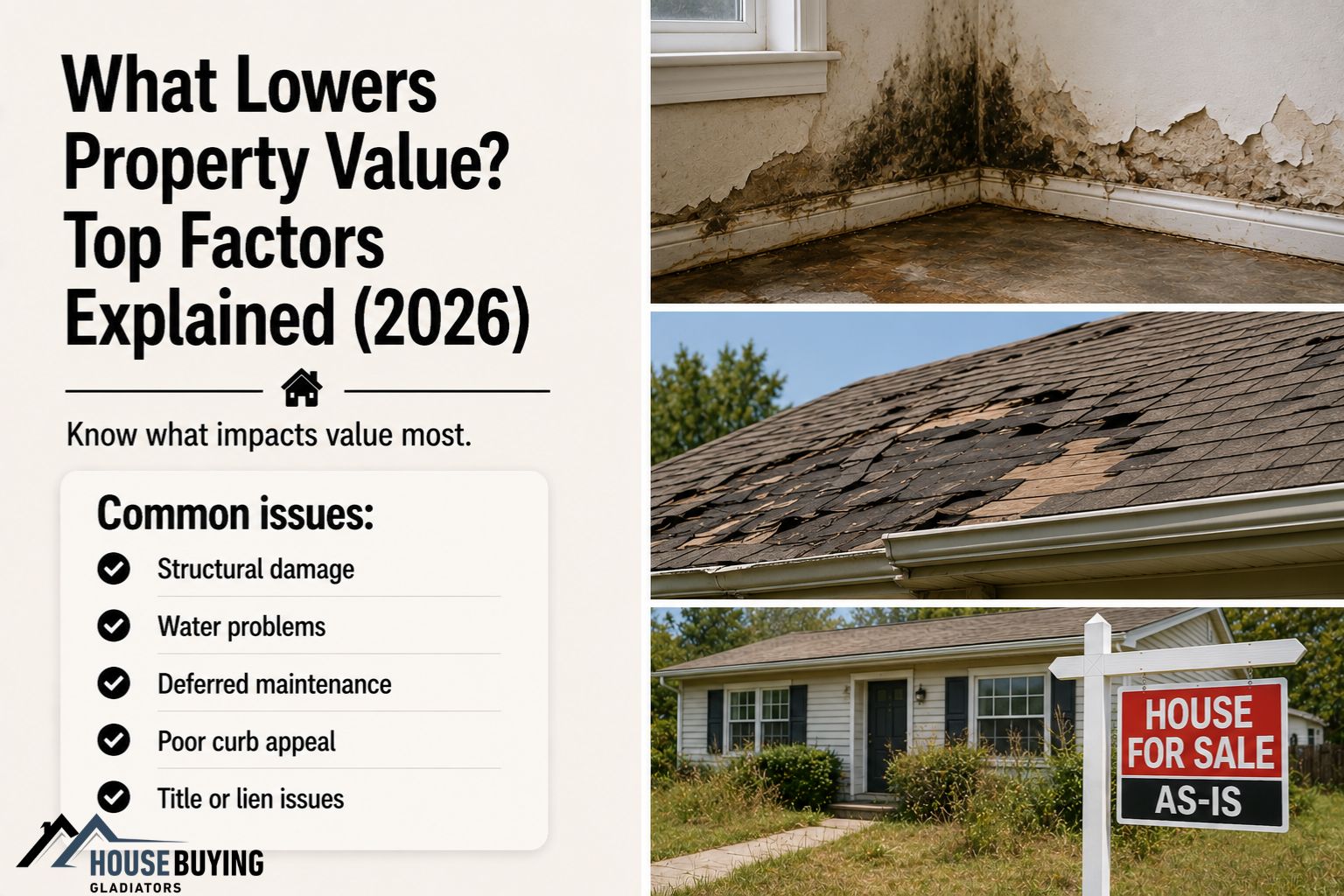
If you’re wondering what lowers property value, the answer is that both physical property issues and buyer perceptions can affect how much a home is worth. Problems such as water damage, foundation issues, roof damage, mold, structural concerns, deferred maintenance, title issues, and unfavorable market conditions can all reduce value. However, not every issue affects property value equally.
Many homeowners assume cosmetic flaws have the biggest impact on price.
In reality, buyers, appraisers, lenders, and insurers often focus more heavily on risk. Issues that create uncertainty, expensive repairs, financing obstacles, or future liability frequently have a greater impact on value than outdated finishes or minor cosmetic imperfections.
The good news is that some factors are manageable, while others may have less impact than homeowners expect. Understanding which issues matter most can help you make smarter decisions before selling, refinancing, or investing in improvements.
Many homeowners ask what lowers property value because they want to avoid costly mistakes before selling. Understanding what lowers property value can help prioritize repairs and focus on issues that matter most to buyers.
This guide explains the biggest factors that lower property value, why buyers and lenders care about certain issues, and which problems tend to have the greatest influence on a home’s marketability and final sale price.
What Lowers Property Value the Most?
Property value is often reduced by issues that increase risk, limit financing options, create safety concerns, require major repairs, or reduce buyer demand. While cosmetic imperfections may affect appeal, serious structural, financial, legal, and condition-related problems typically have the greatest impact on value.
Many homeowners focus on appearance. However, buyers often focus on future costs.
As a result, problems that create uncertainty or significant expenses frequently cause larger pricing adjustments than aesthetic concerns alone.
Comparison Table: Common Factors That Lower Property Value
| Factor | Potential Impact on Value |
|---|---|
| Foundation Problems | High |
| Structural Damage | High |
| Water Damage | High |
| Mold Issues | High |
| Roof Damage | Moderate to High |
| Fire Damage | Moderate to High |
| Termite Damage | Moderate to High |
| Code Violations | Moderate to High |
| Tax Liens & Title Issues | Moderate |
| Unpermitted Work | Moderate |
| Poor Location Factors | Moderate |
| Deferred Maintenance | Moderate |
| Outdated Finishes | Low to Moderate |
| Cosmetic Issues | Low |
Why Some Problems Matter More Than Others
Not all property issues create the same level of concern.
For example, outdated countertops may discourage some buyers. However, a cracked foundation can affect:
- Financing approvals
- Appraisals
- Insurance availability
- Repair costs
- Long-term structural stability
Consequently, buyers often view major structural concerns differently than cosmetic upgrades. Furthermore, structural issues may create financing challenges that limit the pool of qualified buyers. As a result, these problems often have a greater impact on value than appearance-related concerns.
What Most Homeowners Get Wrong
Many homeowners assume the cost of repairs equals the reduction in value.
However, buyers often discount properties based on:
- Repair costs
- Uncertainty
- Project management time
- Financing limitations
- Potential hidden damage
As a result, the reduction in value can sometimes exceed the actual repair estimate. In addition, buyers may account for future risks that are difficult to quantify. Therefore, properties with significant uncertainty often receive lower offers than sellers expect.
Key Takeaway
The issues that lower property value the most are usually those that increase risk, limit financing options, or create uncertainty about future costs. Understanding this distinction helps explain why some problems have a much greater impact than others.
Property Problems That Commonly Reduce Home Value
Physical property defects are among the most common causes of reduced property value because they often create repair costs, financing concerns, and buyer hesitation.
Although every property is different, certain issues consistently attract attention from buyers, appraisers, lenders, and insurers.
Water Damage
Water damage is one of the most common factors that lowers property value because it can lead to multiple secondary problems.
Potential concerns include:
- Mold growth
- Structural deterioration
- Damaged flooring
- Electrical issues
- Hidden moisture
Consequently, buyers often view water damage as a larger risk than the visible damage alone.
Mold Problems
Mold can affect:
- Buyer confidence
- Indoor air quality concerns
- Remediation costs
- Financing requirements
As a result, known mold issues frequently influence both negotiations and perceived value.
Foundation Problems
Foundation concerns often receive significant attention because they may affect:
- Structural integrity
- Safety
- Future repair costs
- Financing eligibility
For that reason, foundation issues are frequently among the most impactful value-reducing problems.
Resources from HomeLight also note that major foundation concerns can affect buyer confidence, financing options, and overall marketability.
Roof Damage
Roofing issues can lower value because buyers often associate them with future expenses and potential water intrusion.
Potential concerns include:
- Active leaks
- Aging roofs
- Storm damage
- Structural deterioration
Therefore, roof condition often becomes a major discussion point during inspections.
Structural Damage
Structural problems may involve:
- Load-bearing walls
- Support beams
- Floor systems
- Settlement concerns
Because structural repairs can be expensive, buyers frequently factor these risks into their offers.
Key Takeaway
Water damage, mold, foundation issues, roof damage, and structural concerns consistently rank among the property problems most likely to reduce value because they affect both buyer confidence and future ownership costs.
Why Buyer Perception Matters More Than Many Homeowners Realize
Buyer perception can influence property value just as much as the physical condition of the home. While some issues create measurable repair costs, others reduce value because they increase uncertainty, perceived risk, or future financial concerns.
Many homeowners focus on the actual problem. However, buyers often focus on the potential problems they cannot see.
Consequently, uncertainty often becomes one of the biggest drivers of reduced value.
As a result, two properties with similar defects may receive very different offers depending on how buyers perceive the associated risks.
What Buyers Are Really Evaluating
When viewing a property, buyers often ask themselves:
- How much will repairs cost?
- Could additional problems exist?
- Will financing be difficult?
- Will insurance become more expensive?
- How much time will repairs require?
- Could future resale become harder?
Consequently, uncertainty often becomes one of the biggest drivers of reduced value.
Real-World Example
Two homes have identical roof damage.
The first seller provides:
- Inspection reports
- Contractor estimates
- Repair documentation
The second seller provides little information.
Although the damage is identical, buyers often perceive the second property as riskier.
As a result, the second home may receive lower offers despite having the same repair needs.
What Most Homeowners Get Wrong
Many sellers believe buyers only discount repair costs.
However, buyers frequently discount:
- Uncertainty
- Potential surprises
- Project management responsibilities
- Delays
- Future risks
For that reason, reducing uncertainty can sometimes preserve value more effectively than reducing repair costs.
Key Takeaway
Property value is often influenced by risk perception as much as physical condition. The more confidence buyers have in understanding a property’s condition, the easier it becomes for them to justify stronger offers.
Industry analyses published by Redfin News & Research frequently show that buyer perception and uncertainty can influence both demand and pricing.
Issues That Affect Financing and Appraisals
Certain problems lower property value because they create financing and appraisal challenges. In these situations, the issue affects not only buyer interest but also the buyer’s ability to obtain a mortgage.
Many homeowners focus exclusively on buyers. However, lenders and appraisers often play an equally important role in determining market value and transaction outcomes.
Additionally, financing restrictions can reduce the number of qualified buyers competing for the property. Therefore, value may decline even when buyer interest remains relatively strong.
Why Lenders Care
Mortgage lenders want to ensure the property serves as suitable collateral. As a result, they often evaluate factors that could affect safety, marketability, or future value.
Potential concerns include:
- Structural damage
- Foundation movement
- Significant roof failures
- Electrical hazards
- Water intrusion
- Safety concerns
Consequently, financing restrictions can reduce the pool of qualified buyers.
Why Appraisers Pay Attention
Appraisers evaluate factors that may influence:
- Marketability
- Safety
- Condition
- Functional utility
- Buyer demand
Similarly, appraisers consider how these issues may affect the property’s desirability and overall market value. Therefore, significant defects can influence both appraised value and financing eligibility.
Examples of Issues That Frequently Affect Financing
Potential examples include:
- Foundation problems
- Structural damage
- Severe roof deterioration
- Water damage
- Mold contamination
- Code violations
- Unsafe electrical systems
Because these issues can affect habitability or safety, lenders often scrutinize them carefully. Furthermore, some lenders may require repairs before approving financing.
Key Takeaway
Some property problems reduce value not because buyers dislike them, but because financing becomes more difficult. When fewer buyers can obtain financing, demand often declines. Ultimately, reduced demand can place downward pressure on property value.
Problems That Lower Property Value More Than Most Homeowners Expect
Certain issues create a disproportionately large impact on value because they increase uncertainty, financing concerns, or legal complications.
Many homeowners underestimate how strongly buyers react to certain risks. Furthermore, these issues often create uncertainty that extends beyond the immediate repair costs. As a result, buyers may adjust offers more aggressively than sellers anticipate.
Hidden Water Damage
Visible water damage is concerning. However, hidden moisture issues often create even greater concern because buyers worry about:
- Mold
- Structural deterioration
- Future repairs
As a result, uncertainty can increase discounts and reduce buyer confidence.
Unpermitted Work
Projects completed without required permits may create:
- Financing concerns
- Insurance complications
- Future compliance issues
Consequently, buyers often view unpermitted improvements as a liability rather than an upgrade. Additionally, some lenders may require further inspections before approving financing.
Title Problems and Liens
Potential concerns include:
- Tax liens
- Judgment liens
- Ownership disputes
- Title defects
Because these issues can delay or prevent closing, they often reduce buyer confidence. Moreover, unresolved title issues can shrink the pool of interested buyers.
Code Violations
Unresolved code violations may indicate:
- Safety concerns
- Required repairs
- Future expenses
As a result, buyers frequently adjust offers to account for these risks. In some situations, code violations may also create financing challenges.
Failed Inspection Findings
Many buyers react strongly to inspection reports because they reveal issues that may not have been visible during showings. Therefore, major inspection findings can significantly affect perceived value.
Furthermore, inspection reports often influence negotiations by highlighting risks that buyers may not have previously considered.
Key Takeaway
The problems that lower property value the most are often not the most visible problems. Instead, they are the issues that create uncertainty, legal complications, financing challenges, or future expenses. Ultimately, buyer perception of risk frequently plays a major role in determining value.
Problems That Lower Property Value Less Than Most Homeowners Expect
Not every imperfection has a major impact on value. In fact, many cosmetic concerns influence buyer preferences far more than actual market value.
Many sellers spend significant money fixing issues that buyers view as relatively minor.
Dated Finishes
Potential examples include:
- Older countertops
- Outdated cabinets
- Older flooring styles
- Aging fixtures
Although these features may affect appeal, they often create smaller value adjustments than major structural concerns.
Paint Colors
Unusual paint colors may reduce appeal for some buyers.
However, paint is generally considered one of the easiest and least expensive changes a buyer can make.
Minor Cosmetic Wear
Examples include:
- Small wall imperfections
- Worn carpet
- Outdated décor
- Minor landscaping issues
Because these issues are relatively inexpensive to address, they often have a limited impact on overall value.
Buyer Preference vs. Property Value
One of the biggest misconceptions in real estate is that every disliked feature reduces value significantly.
In reality, there is a difference between:
| Buyer Preference Issue | Value Impact |
|---|---|
| Paint Colors | Usually Low |
| Outdated Décor | Usually Low |
| Cosmetic Wear | Usually Low |
| Structural Damage | Often High |
| Foundation Problems | Often High |
| Water Damage | Often High |
What Many Homeowners Discover
The issues they worry about most are not always the issues buyers worry about most.
For example, a homeowner may spend thousands updating cosmetic features while overlooking a roof issue that buyers view as far more important.
Key Takeaway
Many cosmetic imperfections affect marketability more than actual value. Buyers often focus far more heavily on risk, safety, financing concerns, and future repair costs than on aesthetics alone.
Can You Increase Property Value Before Selling?
Yes, certain improvements can increase property value before selling. However, not every repair or upgrade produces a positive return on investment. The most effective improvements often address issues that create buyer concern, financing obstacles, or appraisal challenges.
Many homeowners assume any improvement will increase value. However, buyers typically pay more attention to major risks than cosmetic upgrades. As a result, fixing a roof leak may provide a greater return than replacing perfectly functional countertops.
Improvements That Often Protect Value
Potential examples include:
- Addressing active water damage
- Repairing roof leaks
- Correcting safety hazards
- Resolving structural concerns
- Fixing major plumbing issues
- Eliminating electrical hazards
Because these issues affect buyer confidence and financing eligibility, addressing them may help preserve value. Furthermore, resolving major concerns can expand the pool of potential buyers.
Improvements That May Have Limited Impact
Potential examples include:
- Luxury upgrades
- Highly personalized renovations
- Trend-driven improvements
- Expensive cosmetic projects
Although these projects may improve appearance, they do not always generate a proportional increase in value. Instead, buyers may focus more heavily on condition-related issues that affect risk and future costs.
Practical Insight
Before investing in major improvements, homeowners should evaluate whether the expected increase in value is likely to exceed the cost of the work. Additionally, comparing repair costs against potential buyer discounts can provide a more realistic picture of the financial outcome.
Understanding what lowers property value can help homeowners prioritize repairs that are most likely to improve buyer confidence and marketability.
Key Takeaway
The best improvements are often the ones that reduce buyer concerns, eliminate financing obstacles, and improve marketability. Ultimately, focusing on high-impact issues typically produces better results than spending heavily on cosmetic upgrades alone.
Repair the Property or Sell As-Is?
The decision to repair or sell as-is depends on the severity of the issues, available resources, market conditions, and the homeowner’s goals.
In some situations, repairs may increase value and attract more buyers. However, selling as-is may provide a better overall financial outcome when repair costs are substantial or time is limited.
Therefore, homeowners should evaluate both the potential value increase and the total cost of completing repairs before making a decision.
Situations Where Repairs May Make Sense
Repairs often make sense when:
- Costs are manageable
- Financing concerns can be resolved
- The local market favors move-in-ready homes
- The seller has sufficient time and resources
Consequently, repairs may expand the pool of potential buyers.
Situations Where Selling As-Is May Be Smarter
Selling as-is may make more sense when:
- Repair costs are substantial
- Time is limited
- Multiple issues exist
- Funds are unavailable
- Extensive renovations are required
Rather than investing additional money into the property, some homeowners choose to let buyers handle future improvements.
Comparison Table: Repair vs Sell As-Is
| Factor | Repair Before Selling | Sell As-Is |
|---|---|---|
| Upfront Cost | Higher | Lower |
| Time Required | Longer | Faster |
| Buyer Pool | Larger | Smaller |
| Financing Flexibility | Greater | More Limited |
| Financial Risk | Higher | Lower |
| Potential Sale Price | Higher | Usually Lower |
| Project Management | Required | Minimal |
What Most Homeowners Get Wrong
Many homeowners focus exclusively on achieving the highest sale price.
However, the highest sale price does not always produce the highest net proceeds.
Repair costs, holding costs, delays, and unexpected expenses can all affect the final outcome.
Key Takeaway
The best option is usually the one that balances potential proceeds, risk, timeline, and available resources.
What Most Homeowners Get Wrong About Property Value
Many homeowners overestimate the impact of cosmetic issues and underestimate the impact of risk-related problems.
Many homeowners spend time researching what lowers property value because they want to avoid making costly repair and renovation decisions before selling.
As a result, they often spend money addressing low-impact concerns while overlooking issues that buyers, lenders, and appraisers consider far more important.
One reason homeowners misunderstand what lowers property value is that buyers, lenders, and appraisers often evaluate risk differently than sellers do.
Common Misconceptions
Cosmetic Problems Destroy Value
In reality, minor cosmetic issues often have a relatively small impact compared to major structural, financial, or condition-related concerns.
Repair Costs Equal Value Reduction
Buyers frequently discount properties for:
- Uncertainty
- Project management
- Future risks
- Financing limitations
Consequently, value reductions sometimes exceed actual repair costs.
Buyers Think Like Sellers
Homeowners often focus on what they love about a property.
Buyers, however, frequently focus on potential expenses and future risks.
Every Upgrade Adds Value
Some upgrades improve enjoyment without significantly increasing market value.
Therefore, homeowners should evaluate potential return on investment before making major improvements.
Key Takeaway
Property value is influenced by far more than appearance. Risk, financing, marketability, buyer confidence, and future ownership costs often play a larger role than many homeowners realize.
Frequently Asked Questions
Foundation problems, structural damage, water damage, mold, roof failures, title issues, financing obstacles, and major safety concerns are often among the factors that lower property value the most.
Yes. Water damage can reduce value because it may lead to mold growth, structural deterioration, and future repair costs.
Often, yes. Foundation issues may affect structural stability, financing eligibility, buyer confidence, and future maintenance costs.
Mold can reduce value because buyers often associate it with health concerns, remediation costs, and underlying moisture problems.
Yes. Roof damage can influence buyer confidence, financing approvals, inspection findings, and future ownership expenses.
Yes. Unresolved code violations may create safety concerns, required repairs, and financing challenges.
Tax liens may affect buyer confidence and marketability, particularly when they create title-related complications.
Significant structural issues, safety concerns, deferred maintenance, and condition-related problems often receive the most attention during appraisals.
Sometimes. Repairs that reduce risk, improve safety, or resolve financing concerns often have the greatest impact.
The answer depends on repair costs, expected value increases, market conditions, available funds, and your overall goals.
Conclusion
So, what lowers property value?
Property value is most often reduced by issues that increase risk, create uncertainty, limit financing options, require major repairs, or reduce buyer confidence.
What many homeowners discover is that the biggest value reductions are not always caused by cosmetic issues. More often, financing challenges, structural concerns, title problems, and future ownership costs have the greatest impact on marketability and price.
Whether you’re preparing to sell, refinance, or invest in improvements, understanding what truly affects value can help you make smarter decisions and avoid unnecessary expenses.
If you’re unsure how specific property issues may affect your home’s value, you can Get Your Cash Offer and explore your options without pressure or obligation.
At House Buying Gladiators, the goal is simple: help homeowners understand their property’s true market position and make confident decisions about what comes next.