Skip to content
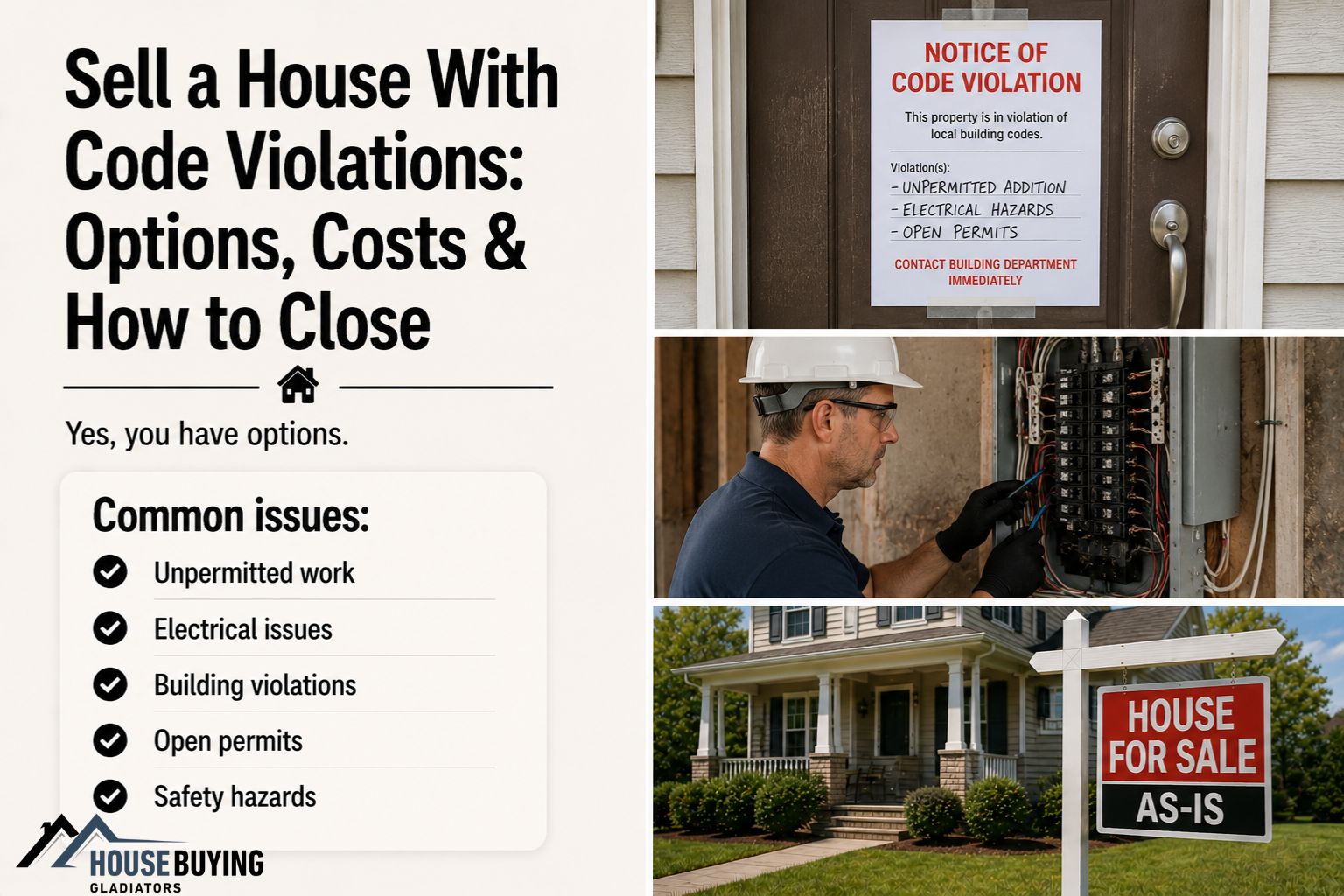
You just found out your home has code violations and now you’re wondering: can you sell a house with code violations? Maybe it’s an unpermitted addition, an electrical issue flagged during an inspection, or a notice from the city you’ve been ignoring for months. Whatever the situation, you’re probably concerned about how these issues could affect your sale.
It doesn’t have to kill the deal. You can sell a house with code violations, and homeowners do it every day. But how you handle the situation often determines whether you walk away with a fair outcome or spend months dealing with repairs, holding costs, and failed transactions.
This guide covers everything you need to know: what different violations actually mean for your sale, what it costs to fix them (and when it may not be worth it), how disclosure works, and what buyers are really thinking when they see code-related issues during the purchasing process.
Want to skip repairs and sell as-is? House Buying Gladiators buys homes with code violations, open permits, and unpermitted work no fixes required. Get your free cash offer today →
Can You Legally Sell a House With Code Violations?
Yes. There is no law that prevents you from selling a property with unresolved code violations in most jurisdictions. Buyers, investors, and house flippers purchase properties with violations every day.
What you generally cannot do is knowingly conceal violations from buyers. Disclosure requirements vary by state, but sellers often must disclose known material defects, and many code violations qualify as material issues.
The more important question isn’t whether you can sell it’s which approach gives you the best financial outcome given your timeline, the severity of the violations, and what it would actually cost to fix them.
Your Three Main Options
- Fix the violations before listing higher upfront cost, potentially larger buyer pool
- Disclose and sell with violations unresolved price accordingly, negotiate from a position of transparency
- Sell as-is fastest option, typically attracts cash buyers and investors
Each path has different costs, timelines, and trade-offs. This guide walks through all of them.
Understanding Different Types of Code Violations
Not all violations are equal. A missing smoke detector is a very different problem from an illegal structural addition and buyers, lenders, and insurers treat them very differently.
Common Types of Code Violations
Building code violations involve construction that doesn’t meet local standards framing, insulation, fire separation, structural elements.
Electrical violations include unpermitted panel upgrades, improper wiring, lack of GFCI outlets in required areas, or amateur electrical work done without inspection.
Plumbing violations cover unapproved pipe materials, unpermitted drain modifications, water heater issues, or work done without a licensed plumber where required.
Zoning violations involve using the property in a way the local zone doesn’t permit running a business from a residential property, building too close to property lines, or adding a structure that exceeds allowed coverage.
Permit violations often arise when homeowners complete renovations, additions, or improvements without obtaining the required permits. Among all code-related issues, unpermitted work is one of the most common challenges sellers encounter.
Property maintenance violations often arise when local code enforcement departments typically issue for conditions such as overgrown vegetation, peeling paint, broken fences, accumulated debris, or other exterior maintenance concerns.
Fire safety violations include missing or non-functional smoke detectors, blocked egress, improper storage, or fireplace/chimney issues.
Why the Type of Violation Matters
The type and severity of the violation determines how buyers respond, whether lenders will finance the property, and how much it will cost to resolve. A single major structural or electrical violation can affect a sale more than five minor maintenance items combined.
Minor Violations vs. Major Violations
Minor Violations
The Minor violations are typically inexpensive to correct and don’t raise safety or habitability concerns. Common examples include:
- Missing or non-functioning smoke detectors ($20–$50 each)
- Broken or missing handrails ($100–$400)
- Peeling exterior paint (cost varies by surface area)
- Minor grading or drainage issues
- Overgrown vegetation cited by code enforcement
These issues rarely affect financing and usually don’t cause buyers to walk away.
Major Violations
Major violations involve safety hazards, structural concerns, or significant unpermitted work. These can affect financing, reduce your buyer pool, and require substantial investment to resolve. Examples include:
- Unsafe electrical panels or wiring
- Structural deficiencies (foundation, framing, load-bearing walls)
- Illegal additions without permits
- Significant plumbing defects
- Fire code violations affecting habitability
- Unpermitted ADUs or garage conversions
| Factor | Minor Violations | Major Violations |
|---|---|---|
| Typical repair cost | $100 – $2,000 | $5,000 – $50,000+ |
| Buyer reaction | Mild concern | Significant concern |
| Financing impact | Usually minimal | Can prevent loan approval |
| Resolution timeline | Days to weeks | Weeks to months |
| Effect on value | Small | Often significant |
Unpermitted Work: One of the Most Common Issues Sellers Face
Many homeowners discover code-related issues only when preparing to sell their property, and unpermitted work is often the reason.
This issue arises when renovations, additions, or improvements are completed without obtaining the required permits or inspections from the local building department.
Common examples include:
- Garage conversions to living space
- Basement finishing
- Deck or patio additions
- Accessory dwelling units (ADUs)
- Electrical panel upgrades
- Room additions
Why Unpermitted Work Is a Problem for Sellers
When improvements are completed without permits, there is no official record confirming that the work was inspected and approved. As a result, unpermitted work can create concerns for buyers, lenders, and insurance providers.
For buyers: They may view the property as a higher-risk purchase because they cannot easily verify whether the work meets current building and safety standards. If problems emerge after closing, they may become responsible for addressing them.
For lenders: Financing can become more complicated because some loan programs require properties to meet minimum standards. In addition, appraisers may not include unpermitted additions in the home’s official square footage.
For insurers: Coverage can also be affected. In some situations, insurance policies may limit or exclude coverage for structures, systems, or improvements that were not properly permitted or inspected.
Options for Dealing With Unpermitted Work
Retroactive permitting (“permit amnesty”): Some municipalities allow homeowners to obtain permits after the fact. This typically involves an inspection of the existing work and corrections if it doesn’t meet current code. Cost varies significantly depending on the scope of work and local fees budget $500 to $5,000+ for the permitting process alone, not counting any required corrections.
Disclose and sell as-is: Buyers can be informed of the unpermitted work and factor it into their offer. Cash buyers and investors are often comfortable taking this on.
Remove the unpermitted addition: In some cases, the least expensive option is removing the addition and restoring the original condition though this is rarely practical for large additions.
Open Permits vs. Code Violations: What’s the Difference?
These terms are often confused but they mean different things.
An open permit means someone pulled a permit for work but never completed the final inspection. The work may actually be fine it just wasn’t formally signed off. Open permits frequently appear on title searches and can delay or complicate closings.
A code violation means the property currently fails to meet local requirements, whether or not a permit was ever involved.
| Factor | Open Permit | Code Violation |
|---|---|---|
| What it means | Work started but not finalized | Property doesn’t meet current standards |
| Safety concern | Not necessarily | Often yes |
| Resolution | Final inspection or closure | Correction + inspection |
| Discovered when | Title search | Inspection or city records |
| Buyer impact | Can delay closing | Can affect financing and value |
An open permit does not automatically mean a code violation exists. But leaving one unresolved can flag issues during title review and create last-minute closing problems. Resolving open permits before listing or at least knowing their status reduces the risk of surprises.
Do You Have to Disclose Code Violations When Selling?
In most states, yes. Sellers are generally required to disclose known material defects, and code violations typically qualify. Disclosure requirements vary by state, but intentionally concealing known issues can expose sellers to legal liability after closing.
Beyond the legal obligation, disclosure is also a practical strategy. Buyers, home inspectors, lenders, and title companies frequently discover code issues during a transaction. Getting caught concealing a known violation is far more damaging to a deal than disclosing it upfront.
What Typically Needs to Be Disclosed
Depending on your state and the nature of the violations, disclosures may include:
- Known building code violations
- Open or expired permits
- Unpermitted additions or modifications
- Electrical or plumbing deficiencies
- Structural concerns
- City notices or compliance orders
- Outstanding fines
State Disclosure Variation
Disclosure laws and enforcement vary significantly by location:
California: The Transfer Disclosure Statement (TDS) requires sellers to disclose known material defects including any code violations, unpermitted work, or building department notices.
Florida: Sellers must disclose all known facts that materially affect the value of the property and are not readily observable. Code violations and unpermitted additions fall squarely within this requirement.
New York: The Property Condition Disclosure Act requires disclosure of alterations made without required permits and any notices of violation received from governmental agencies.
Texas: The Seller’s Disclosure Notice specifically asks about city code violations, unpermitted work, and any notices received from local authorities.
Always consult a local real estate attorney for guidance specific to your state and situation.
What Happens During a Code Inspection?
If you’re dealing with a suspected or known violation, understanding what a code inspection involves helps you prepare and helps you explain the situation clearly to buyers.
Who Performs Code Inspections?
Code inspections are performed by local government officials typically employees of the city or county building department or code enforcement office. They are not the same as a private home inspector.
You may encounter a code inspection in two scenarios: (1) a city inspector initiates it based on a complaint or routine enforcement, or (2) you proactively request an inspection to determine the status of unpermitted work before listing.
What Inspectors Look For
Code inspectors evaluate whether a property complies with applicable building, zoning, safety, and maintenance codes. Depending on the reason for the inspection, they may examine:
- Structural elements (framing, foundation, roof)
- Electrical systems
- Plumbing systems
- Mechanical systems (HVAC)
- Fire safety features (smoke detectors, egress, fire separation)
- Zoning compliance (land use, setbacks, structure coverage)
- Property maintenance (exterior condition, vegetation, debris)
What Happens After an Inspection
If violations are found, the inspector issues a notice of violation or correction order that specifies what must be fixed and by when. Deadlines vary but are typically 30 to 90 days for non-emergency issues. Failure to comply can result in fines, additional notices, or in severe cases, an unsafe structure declaration.
If you proactively request a permit inspection for older work, the inspector determines whether the work meets current code. Corrections may be required before a permit can be closed.
How Much Do Code Violation Corrections Cost?
Costs vary enormously by violation type and scope. Based on data from Angi and HomeAdvisor:
| Violation Type | Typical Correction Cost |
|---|---|
| Smoke detectors / CO detectors | $50 – $300 |
| Handrail installation or repair | $150 – $600 |
| GFCI outlet installation | $100 – $300 per outlet |
| Electrical panel upgrade | $1,500 – $4,000 |
| Unpermitted addition retroactive permit | $500 – $5,000+ (plus corrections) |
| Structural repairs | $5,000 – $50,000+ |
| Plumbing corrections | $500 – $5,000+ |
| Full unpermitted room addition legalization | $10,000 – $30,000+ |
These figures are ranges get local contractor estimates before making any decisions.
How Code Violations Affect Property Value
Code violations can reduce market value, but the impact is not uniform. Minor maintenance citations rarely move the needle significantly. Major safety violations, structural issues, or widespread unpermitted work can meaningfully affect both buyer demand and appraised value.
Factors that influence the value impact:
- Severity and type of the violation
- Cost to correct
- Whether the issue affects safety or habitability
- Financing availability for buyers
- Local market conditions and buyer demand
- Number of violations and complexity of resolution
Buyers typically factor in not just the repair cost but also the hassle, time, permit fees, contractor coordination, and uncertainty of what else might be discovered once work begins. This is why buyer discounts often exceed the direct repair cost especially when violations involve unpermitted work or hidden systems like electrical or plumbing.
Should You Fix Code Violations Before Selling?
Not always. The decision depends on the cost of repairs, your timeline, your available funds, and what the market will support.
Fixing violations before listing may make sense when:
- Repairs are relatively affordable (under $3,000–$5,000)
- The violation affects financing and limits your buyer pool significantly
- The issue creates genuine safety concerns
- Your local market strongly favors move-in-ready homes
- The violation is straightforward to resolve with a clear permit path
Selling as-is may make more sense when:
- Correction costs are substantial or uncertain
- Multiple violations exist and total repair cost is high
- You’re working with a tight timeline
- Unpermitted work would require expensive teardown or major correction
- You don’t have capital available for repairs upfront
The Question That Actually Matters
Most sellers focus on getting the highest sale price. A better question is: which option leaves you with the most money after accounting for repair costs, holding costs, permit fees, contractor delays, and closing costs?
A $20,000 higher sale price after $18,000 in repairs, three months of mortgage payments, and a delayed closing is often a worse outcome than selling as-is at a lower price and closing in two weeks.
| Factor | Fix First | Sell As-Is |
|---|---|---|
| Upfront cost | Higher | None |
| Timeline | Longer | Faster |
| Buyer pool | Larger | Smaller (cash/investors) |
| Sale price | Potentially higher | Lower |
| Net proceeds | Depends on repair costs | Depends on discount |
| Risk | Cost overruns, delays | Negotiation on price |
Can Code Violations Affect Buyer Financing?
Yes especially for major violations. Lenders want assurance that the property is safe, habitable, and serves as acceptable collateral. Significant code issues can trigger additional inspections, require repairs before loan approval, or in severe cases, result in loan denial.
Government-backed loan programs (FHA, VA, USDA) have the strictest minimum property condition requirements. Structural issues, safety hazards, and major unpermitted additions are most likely to create problems with these loans.
Conventional financing offers more flexibility, but appraisers are still required to note significant deficiencies. If an appraiser flags a code violation or unpermitted addition, the lender may require resolution before funding.
Cash buyers, however, are generally unaffected by lending requirements. As a result, investors and other cash buyers are often a practical option for properties with significant violations.
More importantly, financing challenges usually stem from the underlying safety or property condition issue rather than the word “violation” appearing on a disclosure form. For example, a documented minor violation that is actively being corrected rarely derails financing. In contrast, a major undisclosed structural issue discovered during an appraisal can create significant obstacles and may even prevent loan approval.
City Fines, Compliance Notices, and Outstanding Orders
Some violations involve active enforcement city-issued notices with deadlines, daily fines, or compliance orders that must be resolved before a property can transfer. These require attention before or during a sale.
Common municipal enforcement actions:
- Notice of Violation (NOV) identifies the issue and sets a correction deadline
- Correction Order similar to NOV, may come with reinspection requirements
- Property Maintenance Citation typically minor, involves fines
- Unsafe Structure Notice serious; may restrict occupancy
Why these matter for a sale:
Outstanding notices can appear in title searches. Some jurisdictions place liens on properties for unpaid code enforcement fines, which must be cleared at or before closing. Title companies typically require resolution of active enforcement actions before issuing title insurance.
What to do: Pull your property’s permit and code enforcement history from your local building department before listing. Most municipalities offer this online. Knowing what’s on record eliminates surprises during buyer due diligence.
Real-World Example
A homeowner received a city notice for an unpermitted deck addition three years before deciding to sell. They’d ignored it assuming it would go away. When a buyer’s title search turned it up, the deal nearly fell apart over a $2,200 fine and a reinspection requirement. After the homeowner paid the fine and scheduled an inspection, the deal closed but the delay cost an additional month of carrying costs and nearly lost a motivated buyer. Getting ahead of it before listing would have cost the same money with none of the drama.
What Buyers Actually Care About
Most buyers are not afraid of code violations per se. They are afraid of not knowing what they’re getting into. The uncertainty around hidden costs, required permits, contractor access, and potential further discoveries often creates more anxiety than the violation itself.
Homeowners searching “can you sell a house with code violations” are often surprised to learn that buyers usually focus more on repair costs and risk than the violation itself.
What buyers typically want to know:
- How serious is the violation safety issue or paperwork issue?
- What will it actually cost to fix?
- Is there a clear path to resolution (permit available, contractor identified)?
- Will their lender approve financing?
- Could there be additional hidden problems?
- Is the seller being straight with them?
Documentation reduces fear. Sellers who come to the table with contractor estimates, permit research, municipal records, and a clear explanation of the issue consistently have smoother negotiations than sellers who disclose a violation with no supporting information.
Helpful documentation to prepare:
- Contractor estimates for corrections
- Permit history from the local building department
- Any prior inspection reports
- Engineering reports (for structural issues)
- Correspondence with city/code enforcement
- Repair invoices if any work has already been done
Buyers rarely expect perfection. They want enough information to make an informed decision and price their offer accordingly.
Common Mistakes Homeowners Make When Selling a House With Code Violations
Mistake #1: Assuming the house can’t be sold. Properties with violations sell every day. The violation is a negotiating variable, not a dealbreaker.
Mistake #2: Ignoring city notices. Delays can compound fines, trigger additional enforcement actions, and reduce your options. Address notices early even if you ultimately decide to sell as-is, knowing exactly what you’re dealing with gives you leverage.
Mistake #3: Hiding known problems. Inspectors, lenders, and title companies frequently uncover code issues. Getting caught concealing a known violation creates legal exposure and almost always kills deals at the worst possible moment.
Mistake #4: Only counting repair costs not holding costs. Every month you spend fixing violations costs money: mortgage payments, property taxes, insurance, utilities. A $6,000 repair project that takes four months also costs you $4,000–$8,000 in carrying costs. Factor the full timeline into your math.
Mistake #5: Optimizing for sale price instead of net proceeds. A higher offer after major repairs doesn’t always leave you with more money. Run the full numbers repair costs, permit fees, contractor delays, carrying costs, and closing costs before deciding which path makes financial sense.
Frequently Asked Questions
Yes. Homeowners can legally sell a house with code violations in many situations. However, disclosure requirements, local regulations, and the severity of the violations may affect how the transaction proceeds.
No. Many homeowners sell properties with unresolved violations. Whether repairs make financial sense depends on the cost of corrections, buyer expectations, financing requirements, and your timeline.
Often, yes. The impact depends on the type of violation, estimated repair costs, financing limitations, and buyer demand. Major safety or structural issues typically have a greater effect on value than minor maintenance violations.
Yes. Many homeowners choose to sell as-is rather than spend money correcting violations. This approach may attract a smaller buyer pool, but it can reduce upfront costs and shorten preparation time.
It depends. Local regulations, the type of fine, and the terms negotiated between buyer and seller often determine whether fines must be resolved before closing or can be addressed as part of the transaction.
The fastest option is often selling the property in its current condition rather than completing extensive repairs. This can eliminate renovation delays and allow buyers to evaluate the property based on its existing condition.
It depends on repair costs, market conditions, and your financial goals. If repairs are affordable and likely to increase buyer demand, fixing them may make sense. When costs are substantial or time is limited, selling as-is may provide a better overall outcome.
The most expensive mistakes often include ignoring notices, delaying decisions, underestimating holding costs, and spending money on repairs that do not significantly improve the final outcome.
Conclusion
Yes, you can sell a house with code violations and it happens every day. The violations don’t determine your outcome. Your approach does.
If repairs are affordable, straightforward, and likely to expand your buyer pool significantly, fixing them before listing can make sense. But if you’re looking at major unpermitted work, structural issues, or a long and uncertain correction timeline, selling as-is to a buyer who understands the property’s condition often puts more money in your pocket faster with far less stress.
Before committing to either path, run the full numbers. Don’t just look at the repair estimate factor in permit fees, contractor timelines, carrying costs, and the risk of cost overruns. The highest sale price isn’t always the best outcome.
If you want to skip the repairs entirely and sell your home fast regardless of violations, House Buying Gladiators can help. We buy homes as-is code violations, open permits, unpermitted work, and all with no repairs required and no surprises at closing. Request your free cash offer today →