Skip to content
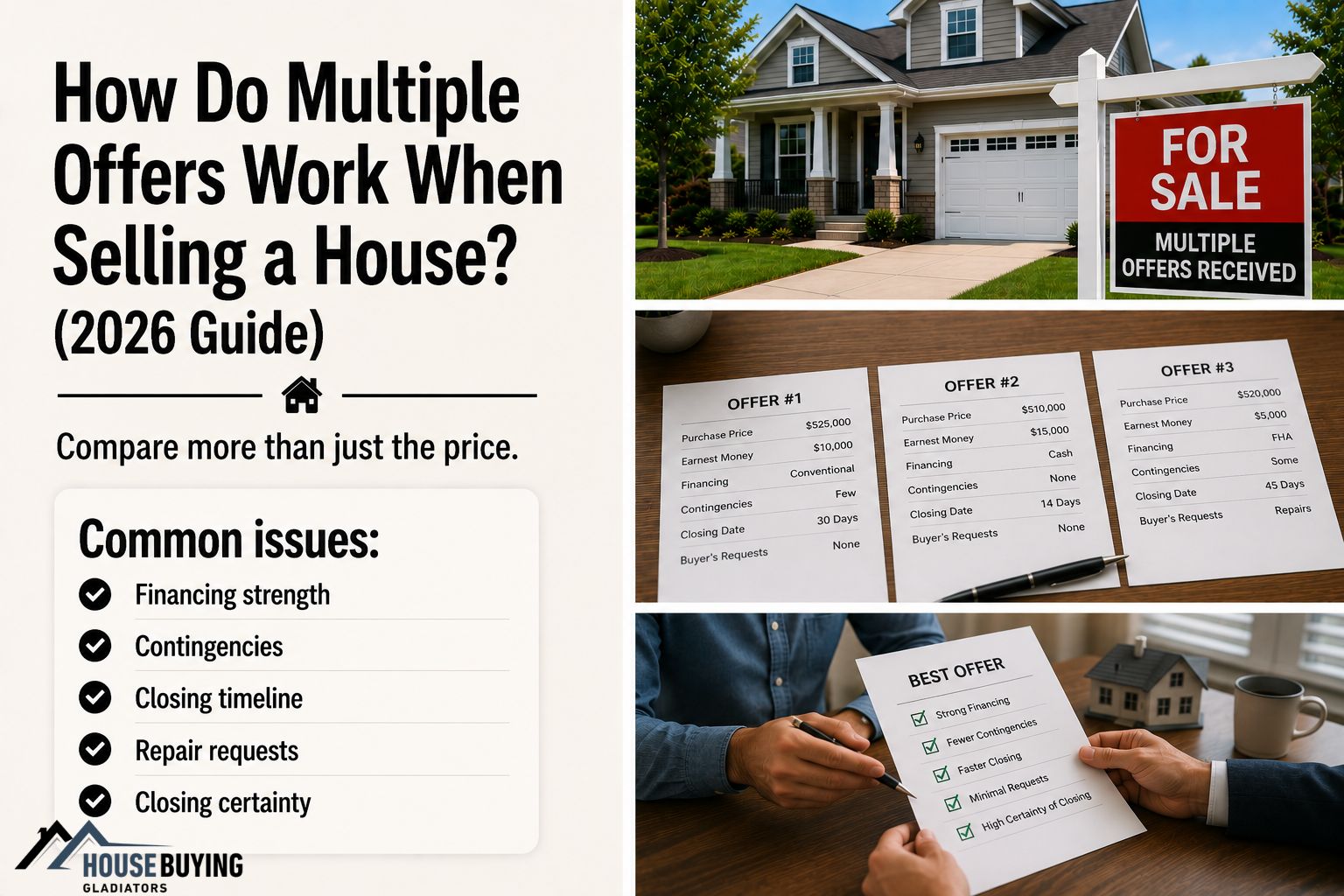
If you are wondering how multiple offers work when selling a house, the short answer is that sellers compare every offer and choose the one that creates the best overall outcome, not simply the highest purchase price.
Many homeowners assume the biggest number automatically wins.
That is not always true.
Financing strength, contingencies, repair requests, closing timelines, and closing certainty often have a bigger impact on a successful sale than price alone.
The strongest offer is usually the one that balances profit, speed, and risk.
Understanding how to evaluate competing offers can help you protect your proceeds, avoid unnecessary delays, and choose the buyer most likely to close successfully.
This guide explains how multiple offers work, what sellers should compare, and how to confidently choose the best offer for your situation.
Multiple Offer Risk-Adjustment Matrix
Multiple Offer Risk-Adjustment Matrix
How Do Multiple Offers Work When Selling a House?
Multiple offers happen when two or more buyers submit offers on your property at the same time. Sellers then compare each offer and choose the one that creates the best overall outcome, not necessarily the highest purchase price.
Price is important, but it is only one piece of the decision.
Financing strength, contingencies, closing timelines, and repair requests can all affect how smoothly the transaction moves forward.
List House ➔ Receive Multiple Offers ➔ Compare Terms ➔ Negotiate ➔ Accept The Strongest Offer
| Factor | Why It Matters |
|---|---|
| Offer price | Impacts your final proceeds |
| Financing strength | Reduces closing risk |
| Contingencies | May delay the transaction |
| Closing timeline | Affects your schedule |
| Repair requests | May increase your expenses |
Many sellers focus only on price.
However, the strongest offer often balances profit, speed, and closing certainty.
If you want to estimate your final payout, how much will I make selling my house can help you calculate your proceeds.
Should You Always Accept The Highest Offer When Selling a House?
No. The highest offer is not always the strongest offer.
A slightly lower offer with stronger financing, fewer contingencies, and a faster closing timeline may create a better overall outcome and reduce the risk of delays.
Price is important, but certainty matters too.
Highest Price ➔ More Conditions ➔ More Risk ➔ Potential Delays
Balanced Offer ➔ Greater Certainty ➔ Smoother Closing
| Scenario | Often The Better Choice |
|---|---|
| Highest offer with many contingencies | ⚠️ It depends |
| Slightly lower offer with stronger financing | ✅ Often yes |
| Cash offer with a fast closing | ✅ Often yes |
| Offer with multiple repair requests | ⚠️ It depends |
Many sellers focus only on the biggest number.
However, the strongest offer often balances profit, speed, and closing certainty.
If you are comparing cash buyers and traditional buyers, should I accept a cash offer on my house explains how to evaluate both options.
What Should Sellers Compare Besides Price?
Do not compare only the purchase price. The strongest offer often balances financing strength, contingencies, closing timelines, and overall closing certainty.
A higher offer can sometimes create more risk if financing problems, repair requests, or lengthy contingencies delay the transaction.
Offer Price ➔ Financing Strength ➔ Contingencies ➔ Closing Timeline ➔ Overall Value
| Factor | Why It Matters |
|---|---|
| Purchase price | Impacts your final proceeds |
| Financing strength | Reduces closing risk |
| Contingencies | May delay the sale |
| Closing timeline | Affects your schedule |
| Repair requests | May increase your expenses |
| Earnest money deposit | Shows buyer commitment |
Many homeowners focus on the biggest number.
However, the offer with the lowest overall risk often creates the smoothest transaction. Understanding how to evaluate offers beyond the purchase price can help sellers look at financing strength, contingencies, closing timelines, and overall closing certainty instead of focusing solely on the offer amount.
If you want to understand what happens after accepting an offer, what happens at closing when selling a house explains the next steps.
How Do Sellers Respond To Multiple Offers When Selling a House?
Sellers have several options when multiple offers arrive. You do not have to immediately accept the first, highest, or fastest offer.
Instead, compare the terms and choose the response that creates the best overall outcome.
Receive Offers ➔ Compare Terms ➔ Negotiate ➔ Accept An Offer ➔ Open Escrow
| Option | What It Means |
|---|---|
| Accept an offer | Choose the strongest overall offer |
| Counteroffer | Negotiate better terms |
| Request highest and best offers | Ask buyers to improve their offers |
| Reject all offers | Continue marketing the property |
Many sellers request highest and best offers when several buyers show strong interest. This gives buyers a fair opportunity to strengthen their terms before you make a final decision. Understanding how highest and best offers work can also help sellers structure the negotiation process, set expectations, and compare competing buyers more effectively.
If your property is attracting little activity instead, what happens if my house doesn’t sell explains what changes homeowners can make.
What Mistakes Should Sellers Avoid During Multiple Offers When Selling a House?
Many homeowners make the mistake of focusing only on price and overlooking factors that can affect closing certainty.
The strongest offer is not always the highest offer.
Avoid these common mistakes before making a final decision.
Multiple Offers ➔ Compare Every Detail ➔ Avoid Costly Mistakes ➔ Choose The Strongest Offer ➔ Close Successfully
| Mistake | Why It Can Be A Problem |
|---|---|
| Choosing only the highest price | Financing or contingencies may create delays |
| Ignoring closing timelines | It may not fit your schedule |
| Overlooking repair requests | Expenses may reduce your proceeds |
| Skipping financing verification | Increases the risk of the deal falling through |
| Rushing the decision | You may overlook a stronger offer |
The goal is to compare the entire transaction, not just one number.
If you still have an active mortgage, can you sell a house with an existing mortgage explains how lenders handle mortgage payoffs during closing.
FAQs: How Do Multiple Offers Work When Selling a House?
Multiple offers happen when two or more buyers submit offers around the same time. Sellers compare price, financing strength, contingencies, repair requests, and closing timelines before choosing the strongest overall offer.
No. Sellers can choose any offer they prefer. Many homeowners prioritize stronger financing, fewer contingencies, and greater closing certainty instead of automatically accepting the highest purchase price.
A highest and best offer is when sellers ask interested buyers to submit their strongest terms before a final decision is made. This often happens in competitive markets with multiple interested buyers.
Yes. Sellers can counteroffer, negotiate terms, or request improvements from multiple buyers before accepting one offer. However, once an offer is accepted, negotiations with other buyers usually end.
Sellers should compare financing strength, contingencies, earnest money deposits, repair requests, closing timelines, and overall closing certainty. Looking at the entire transaction often provides a clearer picture than focusing on price alone.
Sometimes. Cash offers often provide faster closings and fewer financing risks, but they are not automatically the strongest offer. Sellers should still compare all terms before making a decision.
It depends on the market and offer deadlines. Many sellers respond within one to three days, especially when buyer demand is high and several offers arrive at once.
Yes. Buyers may withdraw their offer under certain circumstances, particularly if financing, inspection, or other contingencies allow them to do so.
The transaction usually moves into escrow, where inspections, financing, title work, and closing preparations take place before ownership officially transfers to the buyer.
Sometimes. Strong buyer competition may increase your negotiating power and improve your final outcome, but choosing the strongest overall offer often matters more than maximizing price alone.
Conclusion: How Should You Handle Multiple Offers On Your House?
Receiving multiple offers is usually a good sign because it gives you more choices and greater negotiating power.
However, the highest offer is not always the strongest offer.
Price is important, but financing strength, contingencies, repair requests, and closing certainty often have a bigger impact on a successful sale.
Offer Price ➔ Financing Strength ➔ Closing Certainty ➔ Lower Risk ➔ Better Outcome
Do not focus on one number alone.
Focus on choosing the buyer who offers the best balance of profit, speed, and reliability.
Ready to make a decision? Scroll back to the top of this guide and compare every offer before choosing the strongest one for your situation.