Skip to content
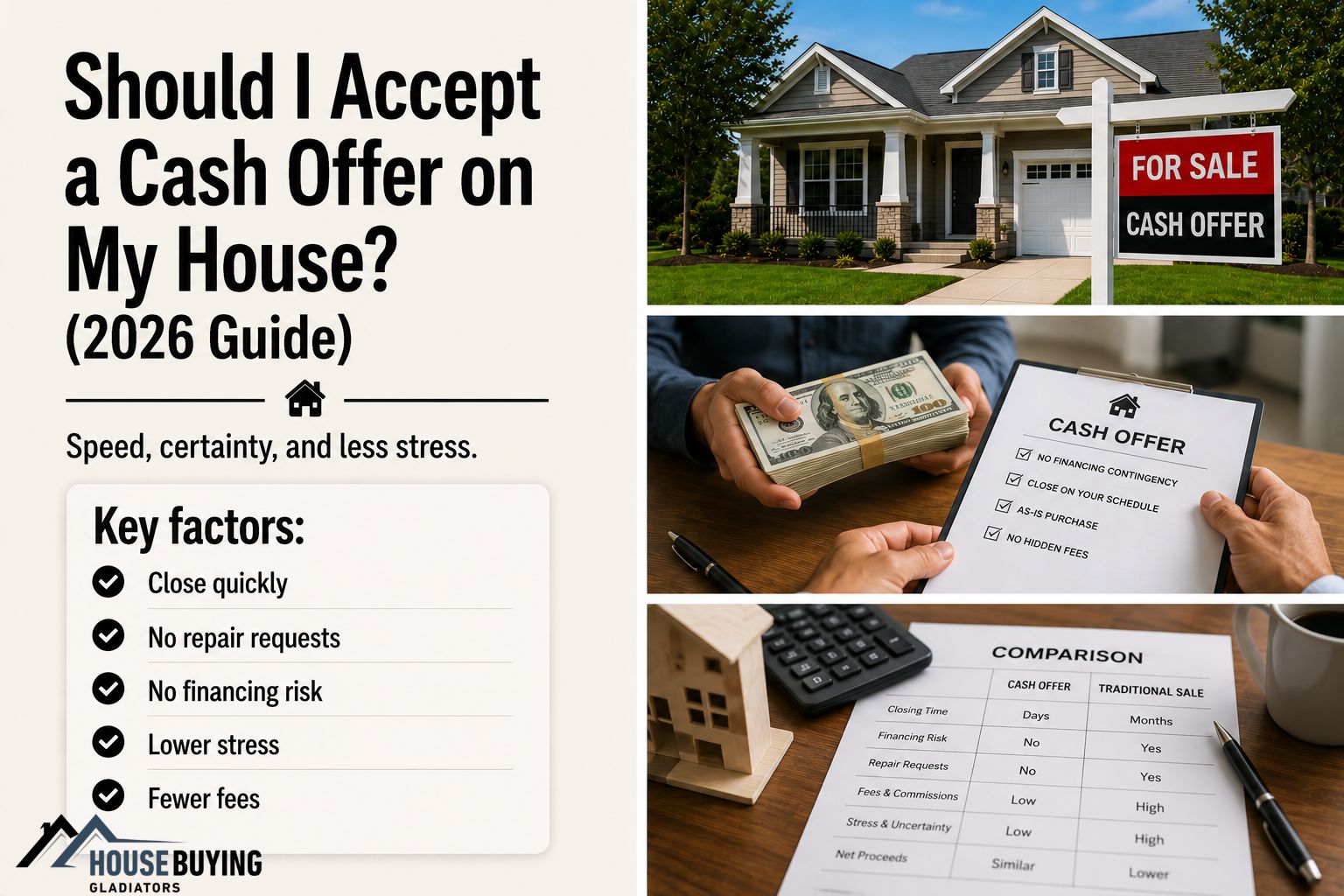
If you are wondering whether you should accept a cash offer on your house, the short answer is that cash offers often make sense when speed, convenience, and closing certainty matter more than getting the highest possible sale price.
Many homeowners automatically choose the biggest offer.
That can be a costly mistake.
A higher offer does not always put more money in your pocket.
Repair requests, financing delays, agent commissions, and months of holding costs can quickly reduce your final proceeds.
In many cases, a lower cash offer can produce a similar financial outcome while helping you avoid unexpected delays and additional stress.
Understanding the true cost of waiting can help you decide whether a cash offer is the right choice for your situation.
Cash vs. Traditional Net Proceeds Calculator
Cash vs. Traditional Net Proceeds Calculator
Cash Sales vs. Traditional Home Listings: When to Accept a Cash Offer on Your House
You should consider accepting a cash offer if speed, convenience, and closing certainty are more important than waiting for the highest possible offer.
A traditional buyer may offer more money upfront. However, repairs, financing delays, and ongoing holding costs can reduce your final payout over time.
Receive Offer ➔ Compare Timelines ➔ Compare Expenses ➔ Compare Risks ➔ Compare Net Proceeds ➔ Make Your Decision
| Factor | Cash Offer | Traditional Buyer |
|---|---|---|
| Closing Timeline | 7 to 21 days | 30 to 60+ days |
| Financing Risk | Very low | Moderate to high |
| Repairs | Usually not required | Often requested |
| Showings | Minimal or none | Multiple showings |
| Contract Price | Sometimes lower | Sometimes higher |
| Closing Certainty | High | Moderate |
| Holding Costs | Often lower | Often higher |
The best offer is not always the highest offer.
Many homeowners discover that ongoing mortgage payments, repair expenses, utilities, insurance premiums, and closing delays can significantly reduce their final proceeds.
Homeowners facing urgent situations often prioritize certainty over waiting for a higher offer.
If you are comparing both selling paths, sell house fast vs list with a Realtor explains the differences in more detail.
When Does Accepting a Cash Offer Make Sense?
Accepting a cash offer often makes sense when time, repairs, or financial pressure make a traditional home sale difficult to manage. Homeowners who prioritize certainty and a faster closing process may benefit more from a cash sale than waiting for the highest possible offer.
Urgent Situation ➔ Fewer Obstacles ➔ Faster Closing ➔ Lower Holding Costs ➔ More Predictable Outcome
| Situation | Why A Cash Offer May Make Sense |
|---|---|
| Foreclosure deadlines | Helps homeowners avoid losing valuable time before an auction date |
| Major repairs needed | Eliminates the need to renovate before selling |
| Inherited property | Simplifies the selling process for heirs |
| Relocating quickly | Helps homeowners move on a shorter timeline |
| Tenant-occupied property | Reduces complications associated with showings |
| Financial hardship | Reduces ongoing monthly expenses |
| Flexible timeline | A traditional sale may still be worth considering |
Cash offers are often less about maximizing your sale price and more about reducing obstacles that can delay a transaction.
Many homeowners choose this path because they want to avoid repair expenses, financing delays, repeated showings, and months of ongoing holding costs.
If your property requires significant repairs, can you sell a house as-is explains another selling strategy homeowners frequently use.
Are Cash Offers Lower Than Traditional Offers?
Sometimes. Cash offers are often lower than traditional offers because cash buyers prioritize speed, convenience, and closing certainty over paying the highest possible price.
However, a higher offer does not automatically mean you will make more money.
Many homeowners focus only on the contract price and overlook the expenses that continue to accumulate throughout a traditional sale.
Higher Offer ➔ More Expenses ➔ Longer Timeline ➔ Reduced Net Proceeds
Cash Offer ➔ Fewer Expenses ➔ Faster Closing ➔ Potentially Similar Net Proceeds
| Factor | Traditional Buyer | Cash Buyer |
|---|---|---|
| Contract Price | Often higher | Sometimes lower |
| Repair Requests | Common | Rare |
| Financing Delays | Possible | Uncommon |
| Closing Timeline | 30 to 60+ days | 7 to 21 days |
| Holding Costs | Often higher | Often lower |
| Closing Certainty | Moderate | High |
A traditional offer may look better at first glance. However, mortgage payments, utilities, insurance premiums, property taxes, HOA dues, and unexpected repair requests can reduce your final payout over time.
For some homeowners, a slightly lower cash offer can produce a similar financial outcome because they avoid many of these additional expenses.
Homeowners who want to compare traditional sales and cash sales can also review Opendoor’s guide on how cash offers work.
If you want to estimate your actual payout, how much will I make selling my house can help you calculate your net proceeds.
How Should You Compare a Cash Offer to a Traditional Offer?
Do not compare only the purchase price. Instead, compare the total financial outcome of each option, including repairs, holding costs, closing timelines, and the likelihood of the sale successfully closing.
The offer that leaves you with the most money is not always the offer with the highest price tag.
Offer Price ➔ Repair Costs ➔ Holding Costs ➔ Closing Risks ➔ Net Proceeds ➔ Final Decision
| Question | Traditional Buyer | Cash Buyer |
|---|---|---|
| How much is the offer? | Higher in some cases | Lower in some cases |
| Are repairs required? | Often yes | Usually no |
| How long will closing take? | 30 to 60+ days | 7 to 21 days |
| Is financing involved? | Yes | Usually no |
| How certain is the closing? | Moderate | High |
Many homeowners make the mistake of comparing only the offer amount. In reality, mortgage payments, property taxes, insurance premiums, utilities, HOA dues, and unexpected repair requests can continue to reduce your proceeds while you wait for a traditional sale to close.
Before accepting any offer, calculate how much money you could keep after subtracting all expenses rather than focusing only on the purchase price. Understanding the steps involved in selling a house can also help you compare timelines, responsibilities, and potential delays associated with a traditional sale.
If you still have an active loan, can you sell a house with an existing mortgage explains how lenders handle mortgage payoffs during closing.
What Hidden Costs Do Homeowners Forget When Comparing Offers?
Many homeowners focus on the offer amount and overlook the expenses that continue to accumulate while they wait for a traditional sale to close.
These ongoing costs can quietly reduce your final proceeds every week your home remains under contract.
Mortgage Payments ➔ Property Taxes ➔ Insurance ➔ Utilities ➔ HOA Dues ➔ Repair Costs ➔ Reduced Net Proceeds
| Expense | Why It Matters |
|---|---|
| Mortgage payments | Continue every month until closing |
| Property taxes | Continue to accrue until ownership transfers |
| Insurance premiums | Stay active throughout the transaction |
| Utilities | Increase overall holding costs |
| HOA dues | Continue until the sale is complete |
| Repair expenses | Can reduce your final payout |
Many homeowners compare a $400,000 traditional offer to a $385,000 cash offer and immediately choose the higher number.
However, the difference can quickly shrink once you factor in several months of carrying costs, unexpected repairs, and closing delays.
This is why comparing net proceeds is often more important than comparing the contract price alone.
Homeowners who want to understand how these timelines affect the selling process can review how long does it take to sell a house.
Get Your Cash Offer
A cash offer is not automatically the best choice.
However, it can be a powerful option if speed, simplicity, and certainty are your top priorities.
Get Your Cash Offer to compare your options, estimate your proceeds, and see whether a fast sale aligns with your timeline and goals.
There is no pressure or obligation.
What Are the Risks of Accepting a Cash Offer on Your House?
Cash offers can simplify the selling process, but homeowners should still verify the buyer before signing an agreement. While many cash buyers are legitimate, accepting an offer too quickly can create unnecessary risks.
The goal is not to avoid cash buyers. The goal is to verify that the offer, the buyer, and the timeline align with your financial goals.
Receive Offer ➔ Verify Buyer ➔ Review Terms ➔ Compare Net Proceeds ➔ Confirm Closing Timeline ➔ Accept Offer
| Potential Risk | Why It Matters | How To Protect Yourself |
|---|---|---|
| Unverified buyer | Some buyers may not have available funds | Request proof of funds |
| Extremely low offer | You may leave equity on the table | Compare multiple offers |
| Hidden contract terms | Unexpected fees may appear | Review the agreement carefully |
| Rushed decisions | You may overlook better opportunities | Compare timelines and proceeds |
| Unclear closing dates | Delays can still happen | Confirm the closing date upfront |
A legitimate cash buyer should provide proof of funds, clear purchase terms, and a realistic closing timeline.
Before signing anything, compare multiple offers and review how much money you could actually keep after all expenses are paid.
If something feels rushed, unclear, or unusually complicated, pause and ask questions before moving forward.
Homeowners who want to understand the final steps after accepting an offer can review what happens at closing when selling a house.
How Can You Tell If a Cash Offer Is Fair?
A fair cash offer is not determined by the purchase price alone. It is determined by the amount of money you keep after factoring in repairs, holding costs, closing timelines, and the certainty of the transaction.
The goal is not to find the highest offer. The goal is to find the offer that creates the best overall financial outcome.
Estimate Home Value ➔ Compare Expenses ➔ Calculate Net Proceeds ➔ Evaluate Closing Risks ➔ Make Your Decision
Before accepting a cash offer, compare multiple offers and verify the buyer’s legitimacy. Learning how to safely sell your house for cash can help you identify red flags and make a more informed decision.
| Question | Why It Matters |
|---|---|
| How does the offer compare to local home values? | Helps determine whether the offer is reasonable |
| How much would repairs cost in a traditional sale? | Affects your final proceeds |
| How many months could a traditional sale take? | Increases holding costs |
| How much do monthly expenses cost? | Reduces your profits over time |
| How certain is the buyer’s ability to close? | Reduces transaction risk |
Many homeowners immediately reject a lower cash offer without calculating the hidden costs attached to a traditional sale.
Mortgage payments, property taxes, insurance premiums, utilities, HOA dues, and repair expenses can quietly reduce your final proceeds while you wait for a buyer to close.
This is why net proceeds often matter more than the purchase price itself.
If you are unsure how values are calculated, what is fair market value of a home can help you understand local pricing.
FAQs: Should I Accept a Cash Offer on My House?
It depends on your priorities. Cash offers often work best for homeowners who value speed, convenience, and closing certainty over maximizing their sale price.
Sometimes. Cash buyers may offer less because they purchase homes as-is, take on more risk, and close much faster.
Most cash sales close within 7 to 21 days because they do not rely on traditional mortgage financing.
Yes. Although less common, a cash sale can still fall through if the buyer backs out, cannot verify funds, or both parties cannot agree on terms.
Not always. Comparing multiple offers can help you understand your home’s value and negotiate a better deal.
In many cases, yes. Most cash buyers purchase homes in their current condition without requiring major repairs.
Sometimes. Closing costs vary by agreement, but many cash buyers cover some or all transaction expenses.
Ask for proof of funds, review the purchase agreement carefully, and confirm the buyer’s reputation before signing anything.
It depends. Cash offers prioritize speed and convenience, while traditional listings may help maximize your sale price.
Not necessarily. A lower offer can sometimes produce similar net proceeds after you subtract repairs, commissions, holding costs, and closing delays from a traditional sale.
Conclusion: Should You Accept a Cash Offer on Your House?
If you are still asking, “Should I accept a cash offer on my house?”, the answer depends on your timeline, financial goals, and the amount of risk you are willing to accept.
Many homeowners automatically chase the highest offer.
That can be a mistake.
A higher contract price does not always produce a better financial outcome.
Repair requests, financing delays, agent commissions, holding costs, and extended closing timelines can significantly reduce the amount of money you ultimately keep.
The best offer is the one that aligns with your priorities, not simply the biggest number on paper.
Before making a decision, compare the entire transaction from beginning to end.
Offer Price ➔ Expenses ➔ Timeline ➔ Closing Risk ➔ Net Proceeds ➔ Final Decision
Ready to compare your options? Scroll back to the top of this guide and evaluate which path best fits your timeline, financial goals, and selling situation.