Skip to content
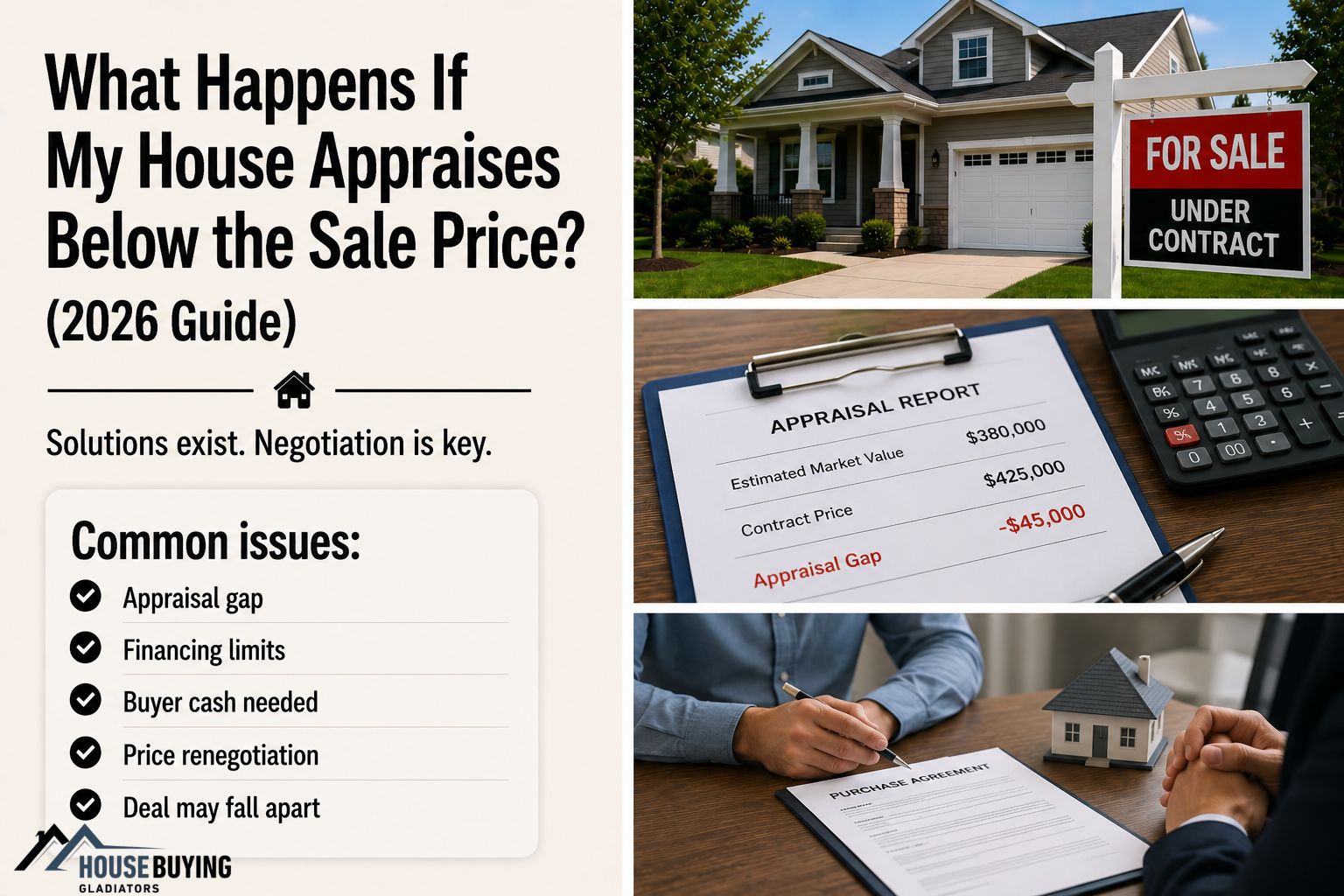
If you are wondering what happens if your house appraises below the sale price, the short answer is that the sale can still move forward, but the buyer and seller will usually need to negotiate a solution before closing.
Many homeowners immediately assume a low appraisal means the deal is over.
That is not always true.
A low appraisal simply means the lender believes the property is worth less than the agreed purchase price.
Because lenders typically base financing on the appraised value rather than the contract price, an appraisal gap can create unexpected challenges.
Fortunately, several solutions may still be available.
The buyer may contribute more cash, the seller may lower the price, both parties may negotiate a compromise, or they may decide to walk away from the transaction.
Understanding your options early can help reduce delays, protect your finances, and keep the sale moving toward closing.
This guide explains why low appraisals happen, how they affect the transaction, and what homeowners can do to successfully navigate the situation.
Appraisal Gap & LTV Estimator
Appraisal Gap & LTV Estimator
What Does It Mean When a House Appraises Below the Sale Price?
When a house appraises below the sale price, it means an independent appraiser believes the property’s market value is lower than the amount the buyer agreed to pay.
This is commonly called an appraisal gap.
Although this situation can create challenges, it does not automatically mean the transaction will fail.
Lenders order appraisals to reduce risk before approving a mortgage because they typically base the loan amount on the appraised value rather than the contract price.
If the appraisal comes in lower than expected, both parties must decide how to handle the difference before closing can move forward.
Offer Accepted ➔ Appraisal Ordered ➔ Lender Reviews Value ➔ Appraisal Gap Created ➔ Negotiate A Solution
| Scenario | Example |
|---|---|
| Agreed sale price | $400,000 |
| Appraised value | $380,000 |
| Appraisal gap | $20,000 |
In this example, the lender may only approve financing based on the $380,000 appraised value instead of the full $400,000 purchase price.
As a result, the buyer may need to bring additional cash, the seller may lower the price, or both parties may negotiate a compromise to keep the transaction together.
Cash buyers usually do not encounter this issue because they are not dependent on mortgage underwriting requirements.
What Does It Mean When a House Appraises Below the Sale Price?
When a house appraises below the sale price, it means an independent appraiser determined the property’s market value is lower than the amount the buyer agreed to pay.
Many homeowners immediately assume the sale is about to collapse.
Fortunately, that is not always the case.
A low appraisal simply creates a new obstacle that both parties must solve before closing can move forward.
Lenders require appraisals to protect themselves from lending more money than the property is worth. Therefore, they typically approve financing based on the appraised value rather than the agreed purchase price.
This difference can create a financing gap that must be addressed before the transaction can continue.
Offer Accepted ➔ Appraisal Ordered ➔ Property Valued ➔ Appraisal Gap Created ➔ Buyer And Seller Negotiate A Solution
| Scenario | Example |
|---|---|
| Agreed sale price | $400,000 |
| Appraised value | $380,000 |
| Appraisal gap | $20,000 |
In this example, the lender may only finance the home based on the $380,000 appraised value instead of the full $400,000 contract price.
As a result, someone must cover the remaining $20,000 difference.
The buyer may bring additional cash, the seller may reduce the price, or both parties may negotiate a compromise.
What most homeowners get wrong is assuming a low appraisal means they overpriced their home.
That is not always true.
Appraisals are based on recent comparable sales, local market conditions, property features, and appraiser judgment. Consequently, even desirable homes can occasionally appraise below the contract price.
Cash buyers usually avoid this issue because they are not dependent on mortgage underwriting requirements.
If you are unsure how values are determined, what is fair market value of a home explains the factors that influence home pricing.
Key Takeaway: A house appraising below the sale price does not automatically kill the deal. Instead, it creates an appraisal gap that both parties must work together to solve before closing.
Who Pays the Difference When a House Appraises Below the Sale Price?
There is no automatic rule that determines who pays the difference when a house appraises below the sale price. Instead, the buyer and seller must negotiate a solution that allows the transaction to move forward.
This difference is known as an appraisal gap.
Many homeowners assume the seller is automatically required to lower the price.
That is not always true.
The final outcome often depends on local market conditions, buyer demand, financing terms, and how motivated both parties are to complete the sale.
Low Appraisal ➔ Appraisal Gap Created ➔ Buyer And Seller Negotiate ➔ New Agreement Reached ➔ Closing Moves Forward
| Option | What Happens | Best For |
|---|---|---|
| Seller lowers the price | The seller reduces the contract price | Sellers who want to preserve the transaction |
| Buyer pays the difference | The buyer brings additional cash to closing | Buyers with extra funds available |
| Buyer and seller split the gap | Both parties share the difference | Situations where compromise makes sense |
| Both parties cancel the deal | The transaction ends if contingency terms allow | Buyers with appraisal contingencies |
Many transactions do not fall apart because of a low appraisal.
Instead, they simply return to the negotiation stage.
What most homeowners get wrong is assuming someone is automatically responsible for paying the difference.
In reality, neither side is legally required to absorb the appraisal gap unless the contract specifically says so.
For example, if buyer demand is strong, sellers may have more negotiating power. However, if the market is slowing down, sellers may be more willing to reduce the price to avoid losing the buyer.
Key Takeaway: A low appraisal is usually a negotiation problem, not a deal-ending problem. The best solution often depends on market conditions, financial flexibility, and how motivated both parties are to complete the sale.
Can Sellers Negotiate After a Low Appraisal?
Yes. Sellers can absolutely negotiate after a low appraisal, and in many cases, that is exactly what happens.
A low appraisal rarely ends the transaction immediately.
Instead, it often sends both parties back to the negotiating table to find a solution that keeps the sale moving toward closing.
The goal is no longer simply agreeing on a purchase price. The goal becomes finding a way to bridge the appraisal gap while protecting everyone’s financial interests.
Low Appraisal ➔ Reopen Negotiations ➔ Evaluate Your Options ➔ Reach A New Agreement ➔ Move Toward Closing
Common negotiation strategies include:
| Negotiation Strategy | How It Helps |
|---|---|
| Lower the sale price | Helps preserve the buyer’s financing approval |
| Request additional cash from the buyer | Allows the seller to protect more equity |
| Split the appraisal gap | Shares the financial burden between both parties |
| Challenge the appraisal | Provides additional comparable sales for review |
| Relist the property | Allows the seller to pursue another buyer |
Many homeowners immediately panic when an appraisal comes in low.
However, this stage is often more about flexibility than failure.
What most sellers get wrong is assuming they must immediately lower the price.
That is not always necessary.
For example, if buyer demand is strong and you have backup interest, you may have more negotiating power. On the other hand, if the market is slowing down, compromising may be the fastest path to closing.
Ultimately, the best negotiation strategy depends on your timeline, local market conditions, and how motivated both parties are to complete the transaction.
Key Takeaway: A low appraisal often creates a negotiation opportunity rather than a deal-ending obstacle. Staying flexible and understanding your options can help keep the sale together.
Can a Buyer Back Out After a Low Appraisal?
Yes. Buyers can sometimes cancel the transaction after a low appraisal if their purchase contract includes an appraisal contingency.
However, a low appraisal does not automatically mean the buyer will walk away.
In many cases, both parties first attempt to negotiate a solution before considering canceling the sale.
An appraisal contingency gives buyers the ability to renegotiate the contract, request price adjustments, or exit the agreement if financing becomes difficult due to a lower-than-expected appraised value.
Low Appraisal ➔ Buyer Reviews Contract Terms ➔ Appraisal Contingency Applies ➔ Negotiate A Solution ➔ Continue Or Cancel The Sale
| Situation | What Usually Happens |
|---|---|
| Appraisal contingency exists | Buyer may renegotiate or cancel |
| Buyer agrees to pay the difference | Transaction moves forward |
| Seller lowers the price | Transaction moves forward |
| Buyer and seller split the gap | Both parties share the burden |
| Both parties cannot agree | The transaction may fall through |
Many homeowners immediately assume a low appraisal means they have lost the buyer.
Fortunately, that is often not the case.
What most homeowners get wrong is assuming the buyer can cancel the transaction for any reason.
In reality, their ability to walk away usually depends on the contract terms, contingency deadlines, and financing requirements.
For example, buyers with strong finances may choose to cover the appraisal gap themselves. Meanwhile, buyers who depend heavily on lender financing may have fewer options available.
Understanding these terms early can help both parties reduce surprises, avoid unnecessary delays, and make more informed decisions throughout the transaction.
Key Takeaway: A low appraisal does not automatically cause buyers to back out. Instead, the outcome usually depends on contract contingencies, financial flexibility, and both parties’ willingness to negotiate. timeline, what happens at closing when selling a house explains what occurs before ownership officially transfers.
What Can Sellers Do to Prevent a Low Appraisal?
Although you cannot control an appraiser’s final opinion, you can take several steps to reduce the risk of your house appraising below the sale price.
Many low appraisals happen because sellers overprice their homes, overlook important property improvements, or fail to provide supporting information before the appraisal takes place.
The goal is not to influence the appraiser.
The goal is to present accurate information that helps support your home’s market value.
Price The Home Correctly ➔ Gather Comparable Sales ➔ Document Improvements ➔ Prepare The Property ➔ Support The Appraisal Process
| Strategy | Why It Helps |
|---|---|
| Price your home realistically | Reduces the risk of creating an appraisal gap |
| Provide recent comparable sales | Gives appraisers additional market data |
| Create a list of improvements | Highlights upgrades that may add value |
| Improve the home’s presentation | Helps showcase the property’s condition |
| Gather permits and receipts | Verifies completed renovations |
Many homeowners unintentionally create appraisal problems before the appraiser ever visits the property.
What most sellers get wrong is assuming buyer demand automatically determines value.
In reality, appraisers rely heavily on recent comparable sales, neighborhood data, property condition, and documented improvements.
For example, if you recently installed a new roof, remodeled the kitchen, or upgraded major systems, creating a list of those improvements can help support the appraisal process.
Many homeowners also benefit from understanding how appraisers evaluate properties before the appraisal appointment. Edina Realty’s guide on home appraisals explains practical ways sellers can prepare their homes, organize improvements, and support the appraisal process.
Ultimately, preventing a low appraisal often starts with setting realistic expectations from the beginning rather than pricing aggressively and hoping the appraisal catches up later.
If you are still determining your asking price, how to determine home value can help you build a more accurate pricing strategy.
Key Takeaway: You cannot control the appraisal itself, but you can improve your chances of a successful valuation by pricing realistically, documenting upgrades, and preparing your property before the appraisal occurs.
Is a Cash Buyer Better If You Are Worried About Appraisal Problems?
In many situations, a cash buyer can help reduce appraisal-related obstacles because traditional mortgage financing is usually not involved.
Since most cash buyers do not rely on lender approval, they often avoid one of the biggest causes of closing delays.
However, that does not automatically make a cash offer the best choice for every homeowner.
The right decision depends on your timeline, financial goals, and overall selling priorities.
Traditional Buyer ➔ Mortgage Approval ➔ Appraisal Required ➔ Additional Risk
Cash Buyer ➔ No Mortgage Financing ➔ Fewer Obstacles ➔ Faster Path To Closing
| Factor | Traditional Buyer | Cash Buyer |
|---|---|---|
| Mortgage approval | Required | Not required |
| Appraisal risk | Higher | Often lower |
| Closing timeline | 30 to 60 days | 7 to 21 days |
| Negotiation complexity | Moderate to high | Usually simpler |
| Closing certainty | Moderate | Often higher |
Many homeowners immediately assume a cash buyer always offers the best solution.
That is not necessarily true.
What most homeowners get wrong is focusing only on speed instead of evaluating the entire transaction.
For example, a traditional buyer may offer a higher purchase price, while a cash buyer may provide greater certainty and fewer obstacles throughout the process.
If appraisal concerns, financing delays, and tight deadlines are becoming major priorities, a cash sale may become an attractive alternative.
Ultimately, the best option is the one that balances your timeline, convenience, and financial outcome.
If you are comparing both approaches, sell house fast vs list with a Realtor explains how each strategy works.
Key Takeaway: Cash buyers can help reduce appraisal-related risks because lender financing is often removed from the equation, but homeowners should still compare speed, convenience, and final proceeds before making a decision.rks.
FAQs: What Happens If My House Appraises Below the Sale Price?
No. A low appraisal does not automatically cancel the transaction. In many situations, buyers and sellers renegotiate the terms, split the appraisal gap, lower the price, or find another solution that allows the sale to continue toward closing.
Yes. Buyers can bring additional cash to closing if they have the available funds. This often happens when buyers strongly want the property and are willing to cover the difference between the appraised value and the contract price.
Yes. Sellers can sometimes challenge a low appraisal by providing additional comparable sales, documenting recent improvements, or asking the lender to review information that may have been overlooked during the appraisal process.
Not always. Many cash buyers do not rely on traditional lender appraisals because mortgage financing is not involved. However, some cash buyers may still order an appraisal for their own evaluation purposes.
Yes. If negotiations fail and the transaction falls through, sellers can relist the property and seek another buyer. However, reviewing your pricing strategy before relisting may help prevent future appraisal challenges.
There is no standard rule. The final outcome usually depends on market conditions, buyer demand, contract terms, and how motivated both parties are to complete the transaction.
Low appraisals are relatively uncommon, but they happen more frequently in rapidly changing housing markets where home values are increasing or decreasing faster than recent comparable sales can reflect.
Yes. A low appraisal can extend the timeline because buyers, sellers, lenders, and agents may need additional time to renegotiate terms, update contracts, or review financing options.
Several factors can contribute to a lower appraisal, including limited comparable sales, changing market conditions, overpricing, property condition concerns, or differences between buyer demand and lender valuations.
Although sellers cannot control the final appraisal, they can reduce the risk by pricing realistically, documenting improvements, gathering permits, and providing recent comparable sales before the appraisal occurs.
Conclusion: A Low Appraisal Does Not Automatically End Your Home Sale
Understanding what happens if your house appraises below the sale price can help you avoid panic and make better decisions throughout the transaction.
Many homeowners immediately assume a low appraisal means the deal is over.
That is rarely true.
In most cases, a low appraisal simply creates an appraisal gap that buyers and sellers must work together to solve.
The buyer may bring additional cash, the seller may lower the price, or both parties may negotiate a compromise to keep the sale moving toward closing.
The key is to stay flexible and understand your options early.
Low Appraisal ➔ Evaluate Your Options ➔ Negotiate A Solution ➔ Move Toward Closing
Ready to move forward? Scroll back to the top of this guide and identify the strategy that best protects your timeline, finances, and overall selling goals.