Skip to content
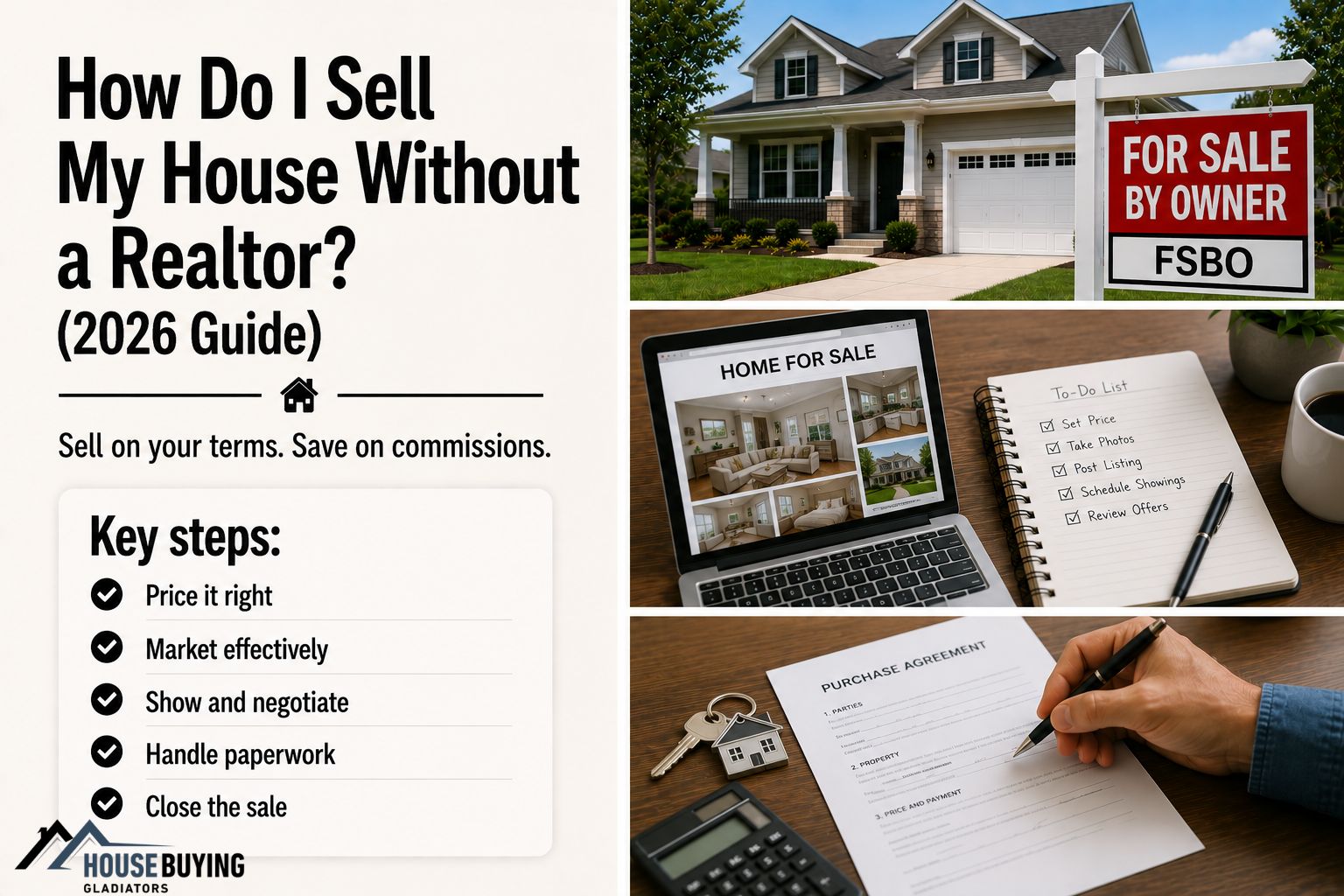
If you are wondering how to sell your house without a Realtor, the short answer is that you can sell it yourself through a For Sale By Owner (FSBO) transaction or sell directly to a cash buyer without hiring a traditional real estate agent.
Many homeowners initially choose this route to save on real estate commissions.
However, commission savings are only one part of the equation.
Selling without a Realtor also means taking full responsibility for pricing the property, preparing the home for sale, marketing the listing, scheduling showings, negotiating offers, managing paperwork, and coordinating the closing process.
For some homeowners, the additional control is worth the extra effort.
For others, the time commitment, legal paperwork, and transaction complexities can quickly become overwhelming.
The right decision often depends on your timeline, your home’s condition, your local market, and how involved you want to be throughout the selling process.
Understanding your responsibilities before listing your property can help you avoid costly mistakes, reduce delays, and choose the selling approach that best fits your goals.
This guide explains how to sell your house without a Realtor, the steps involved, the potential risks, and when alternative selling options may make more sense.
FSBO vs. Realtor Savings Estimator
FSBO vs. Realtor Savings Estimator
Can You Sell Your House Without a Realtor?
Yes. You can legally sell your house without hiring a Realtor in every state. However, selling without an agent means you become responsible for many of the tasks a real estate professional would normally handle.
Generally, homeowners choose one of two paths.
Some complete a For Sale By Owner (FSBO) transaction and manage the entire process themselves. Alternatively, others sell directly to a cash buyer and avoid publicly listing the property altogether.
Ultimately, the right option depends on your timeline, your home’s condition, and how much involvement you want throughout the sale.
Before making a decision, consider how much time, organization, and responsibility you are willing to take on during the transaction.
Choose A Selling Method ➔ Prepare The Property ➔ Manage The Transaction ➔ Complete Closing ➔ Transfer Ownership
| Selling Method | How It Works | Best For |
|---|---|---|
| For Sale By Owner (FSBO) | You handle pricing, marketing, showings, negotiations, and paperwork | Homeowners with time, flexibility, and confidence managing the process |
| Direct Cash Sale | You sell directly to a buyer without publicly listing the property | Homeowners who prioritize speed, convenience, and a simpler transaction |
Both options allow you to avoid traditional listing commissions.
However, avoiding commissions does not eliminate the work involved.
Pricing mistakes, weak marketing, incomplete paperwork, and transaction delays can still affect your timeline and final proceeds.
The goal is not simply to sell without a Realtor. The goal is to choose the selling approach that best fits your schedule, financial goals, and comfort level with managing the process yourself.
What Steps Are Involved When Selling a House Without a Realtor?
Selling a house without a Realtor means you will manage nearly every stage of the transaction yourself, from preparing the property and setting the asking price to negotiating offers and coordinating closing.
The process is manageable for many homeowners, but it requires organization, time, and attention to detail.
Unlike a traditional listing, there is no agent overseeing the transaction on your behalf.
That means every decision becomes your responsibility.
Prepare Home ➔ Price Property ➔ Market The Home ➔ Review Offers ➔ Open Escrow ➔ Complete Closing
| Step | What You Do | Why It Matters |
|---|---|---|
| Prepare the home | Clean, declutter, complete minor repairs, and gather documents | Creates a stronger first impression |
| Price the property | Research local comparable home sales | Helps attract qualified buyers |
| Market the home | Create listings, take photos, and promote the property | Generates buyer activity |
| Review and negotiate offers | Compare offers and negotiate terms | Helps protect your financial outcome |
| Open escrow | Work with a title or escrow company | Begins the closing process |
| Complete closing | Sign documents and transfer ownership | Finalizes the transaction |
Many homeowners underestimate how many moving parts exist throughout the process.
The challenge is not usually selling the house itself. The challenge is staying organized from the moment you list the property until ownership officially transfers to the buyer.
Homeowners who want to improve buyer appeal before listing can also review Investopedia’s guide to home staging, which explains simple ways to present your property more effectively.
Pricing accuracy, clear communication, proper paperwork, and timely responses often have a major impact on how smoothly the transaction unfolds.
If you still have an active mortgage, can you sell a house with an existing mortgage explains how lenders handle loan payoffs during closing.
What Are the Pros and Cons of Selling a House Without a Realtor?
Selling a house without a Realtor can help you save on listing commissions and give you more control over the process, but it also means taking full responsibility for every stage of the sale.
Many homeowners focus only on the potential savings.
However, time commitment, pricing accuracy, paperwork, negotiations, and closing coordination often become equally important factors.
The right choice depends on your schedule, experience level, and how comfortable you are managing a real estate transaction yourself.
More Control ➔ More Responsibility ➔ Potential Savings ➔ Greater Workload ➔ Personalized Selling Experience
| Potential Advantages | Potential Challenges |
|---|---|
| Avoid traditional listing commissions | You manage the entire transaction yourself |
| Control pricing decisions | Incorrect pricing can reduce buyer interest |
| Negotiate directly with buyers | Marketing the property requires time and effort |
| Create your own schedule | Paperwork can become overwhelming |
| Choose your preferred timeline | Mistakes can delay closing |
Selling without a Realtor often works best for homeowners who have time, strong organizational skills, and a clear understanding of the selling process.
Before making a decision, ask yourself a simple question:
Do you want to save on commissions, or do you want someone else to manage the workload for you?
Neither option is automatically better.
The goal is to choose the path that best aligns with your timeline, comfort level, and financial priorities.
How Much Money Can You Save Without a Realtor?
Many homeowners choose to sell without a Realtor to reduce commission expenses and keep more of their proceeds. However, avoiding agent commissions does not automatically mean you will make more money.
Your final outcome depends on pricing accuracy, your selling timeline, ongoing carrying costs, and how effectively you manage the transaction.
Commission savings are only one piece of the equation.
A pricing mistake, extended market time, or delayed closing can quickly offset those savings.
Home Value ➔ Potential Commission Savings ➔ Ongoing Selling Costs ➔ Net Proceeds ➔ Final Financial Outcome
| Expense | Traditional Listing | Selling Without a Realtor |
|---|---|---|
| Listing agent commission | Usually required | Usually avoided |
| Buyer agent commission | Often negotiated | Often still negotiable |
| Title and escrow fees | Still required | Still required |
| Property taxes | Still required | Still required |
| Closing costs | Still required | Still required |
Many homeowners focus entirely on avoiding commissions.
However, several other costs continue regardless of how you sell your house.
Mortgage payments, property taxes, insurance premiums, utilities, HOA dues, and maintenance expenses can continue to accumulate while the property remains unsold.
The goal is not simply to save money on commissions. The goal is to maximize your final proceeds while minimizing unnecessary delays, mistakes, and carrying costs.
If you want to estimate your potential payout, how much will I make selling my house can help you calculate your net proceeds.
What Mistakes Do Homeowners Make When Selling Without a Realtor?
Most mistakes happen because homeowners underestimate how much coordination, preparation, and decision-making a self-managed sale requires.
Selling without a Realtor is possible, but even small mistakes can create delays, reduce buyer interest, or impact your final proceeds.
The good news is that most of these problems are preventable when you prepare before listing your home.
Incorrect Pricing ➔ Reduced Buyer Activity ➔ Transaction Delays ➔ Lost Opportunities ➔ Lower Final Proceeds
Common mistakes include:
| Mistake | Why It Creates Problems |
|---|---|
| Overpricing the home | Buyers may choose more competitive properties |
| Underpricing the home | You may leave money on the table |
| Using poor-quality photos | Fewer buyers schedule showings |
| Missing important paperwork | Escrow and closing can be delayed |
| Waiting too long to respond | Buyers may move on to another property |
Many homeowners assume the hardest part is finding a buyer.
In reality, staying organized throughout the entire sale is often the bigger challenge.
Pricing accurately, preparing documents early, communicating quickly, and understanding the closing process can significantly reduce unnecessary stress and delays.
The goal is not to do everything perfectly. The goal is to avoid the small mistakes that can create bigger problems later.
If paperwork feels overwhelming, what documents do I need to sell my house explains which records homeowners should organize before listing.
When Does Selling a House Without a Realtor Make Sense?
Selling a house without a Realtor often makes sense when you have enough time to manage the sale, understand your local market, and feel comfortable handling pricing, negotiations, paperwork, and buyer communication yourself.
This option tends to work best when the transaction is relatively straightforward.
However, it may become more challenging if you are facing urgent deadlines, financial pressure, major repairs, or complicated ownership situations.
The key is to evaluate your circumstances before deciding which selling path makes the most sense.
Flexible Timeline ➔ Organized Preparation ➔ Active Market Demand ➔ Confident Decision-Making ➔ Successful Self-Managed Sale
| Situation | Selling Without a Realtor May Be A Good Fit |
|---|---|
| You already have an interested buyer | ✅ Yes |
| Your home is in excellent condition | ✅ Yes |
| You have time to manage showings | ✅ Yes |
| You understand local pricing | ✅ Yes |
| You are facing urgent deadlines | ❌ Usually no |
| You want the simplest process possible | ❌ Usually no |
Many homeowners assume avoiding commissions should automatically be the goal.
That is not always true.
Sometimes convenience, speed, and reduced stress become more valuable than maximizing every dollar of savings.
Selling without a Realtor is often easier in a strong housing market because buyer demand may already exist.
However, homeowners dealing with inherited properties, major repairs, tight timelines, tenant issues, or financial pressure may benefit from exploring other options.
The goal is not simply to avoid hiring an agent. The goal is to choose the selling approach that best fits your timeline, comfort level, and overall situation.
If you need to move quickly, sell house fast vs list with a Realtor explains another option homeowners frequently compare.
Is Selling Without a Realtor Better Than Selling to a Cash Buyer?
Not necessarily. Selling without a Realtor and selling to a cash buyer both eliminate the traditional listing process, but they are designed to solve different homeowner problems.
A For Sale By Owner (FSBO) transaction often gives you more control and the potential to maximize your sale price. A cash sale typically prioritizes speed, convenience, and reducing the amount of work required from the homeowner.
Neither option is automatically better.
The right choice depends on your timeline, your home’s condition, your financial priorities, and how involved you want to be throughout the sale.
FSBO ➔ More Control ➔ More Responsibility ➔ Potentially Higher Proceeds
Cash Buyer ➔ Less Work ➔ Faster Closing ➔ Greater Convenience
| Factor | Selling Without a Realtor (FSBO) | Direct Cash Sale |
|---|---|---|
| Timeline | 30 to 90+ days | 7 to 21 days |
| Showings | Multiple | Often one visit |
| Repairs | Often recommended | Usually not required |
| Paperwork | Seller manages most responsibilities | Process is often simplified |
| Convenience | Moderate | High |
| Homeowner involvement | High | Lower |
Many homeowners automatically compare sale prices.
However, price is only one part of the equation.
Your time commitment, carrying costs, repair expenses, and closing certainty can also have a major impact on your final outcome.
For example, waiting several extra months to secure a higher offer may also mean paying additional mortgage payments, property taxes, insurance premiums, utilities, HOA dues, and maintenance expenses.
The goal is not to find a universally better option. The goal is to choose the path that best protects your time, finances, and overall selling experience.
If your property needs significant work before listing, can you sell a house as-is explains another strategy homeowners frequently consider.
FAQs: How Do I Sell My House Without a Realtor?
Yes. Homeowners can legally sell their house without hiring a Realtor in every state. However, you become responsible for pricing the property, marketing the home, negotiating offers, coordinating paperwork, and managing the closing process yourself.
FSBO stands for For Sale By Owner. It means the homeowner sells the property without hiring a traditional real estate agent and personally manages many parts of the transaction from listing to closing.
Yes. Most homeowners still work with a title company or escrow company because they help verify ownership, prepare documents, manage funds, and coordinate the legal transfer of ownership at closing.
Potentially. Many homeowners reduce listing commission expenses, but savings are not guaranteed. Pricing mistakes, longer timelines, marketing expenses, and carrying costs can reduce or offset those potential savings.
Not always. The answer depends on your home’s condition, your local market, and your selling goals. Some homeowners complete minor improvements, while others sell their property in its current condition.
Most homeowners research comparable home sales, local market conditions, online estimates, and recent neighborhood transactions. Accurate pricing is one of the most important factors affecting buyer interest and final proceeds.
Possibly. Some states require a real estate attorney during certain stages of the transaction, while others do not. Requirements vary based on where the property is located.
Yes. Many homeowners choose direct cash buyers when they prioritize speed, convenience, and reducing the amount of work involved in the selling process.
The timeline varies depending on market conditions, pricing, buyer demand, and your marketing efforts. Some sales happen within a few weeks, while others may take several months.
It can be. Selling without a Realtor often works best for homeowners who have time, organizational skills, and confidence managing pricing, negotiations, paperwork, and closing responsibilities themselves.
Conclusion: Decide Whether Selling Without a Realtor Is the Right Choice for You
Knowing how to sell your house without a Realtor can help you decide whether a self-managed sale aligns with your goals, timeline, and comfort level.
Many homeowners initially focus on avoiding commission expenses.
However, saving money is only one part of the decision.
Pricing your home accurately, marketing the property effectively, managing paperwork, negotiating offers, and coordinating closing all become your responsibility when selling without an agent.
For some homeowners, that level of control is worth the additional effort.
For others, convenience, speed, and reducing stress may become more valuable than maximizing every dollar of potential savings.
There is no universally right or wrong approach.
The best option is the one that matches your schedule, your home’s condition, your local market, and the amount of involvement you want throughout the transaction.
Evaluate Your Timeline ➔ Understand Your Responsibilities ➔ Compare Selling Options ➔ Choose The Right Path ➔ Complete Your Sale With Confidence
Before moving forward, ask yourself one simple question:
Do you want full control over the sale, or do you want a simpler process with less day-to-day involvement?
Your answer will often tell you which path makes the most sense.
Ready to make a decision? Scroll back to the top of this guide and compare each option before choosing how you want to sell your home.