Skip to content
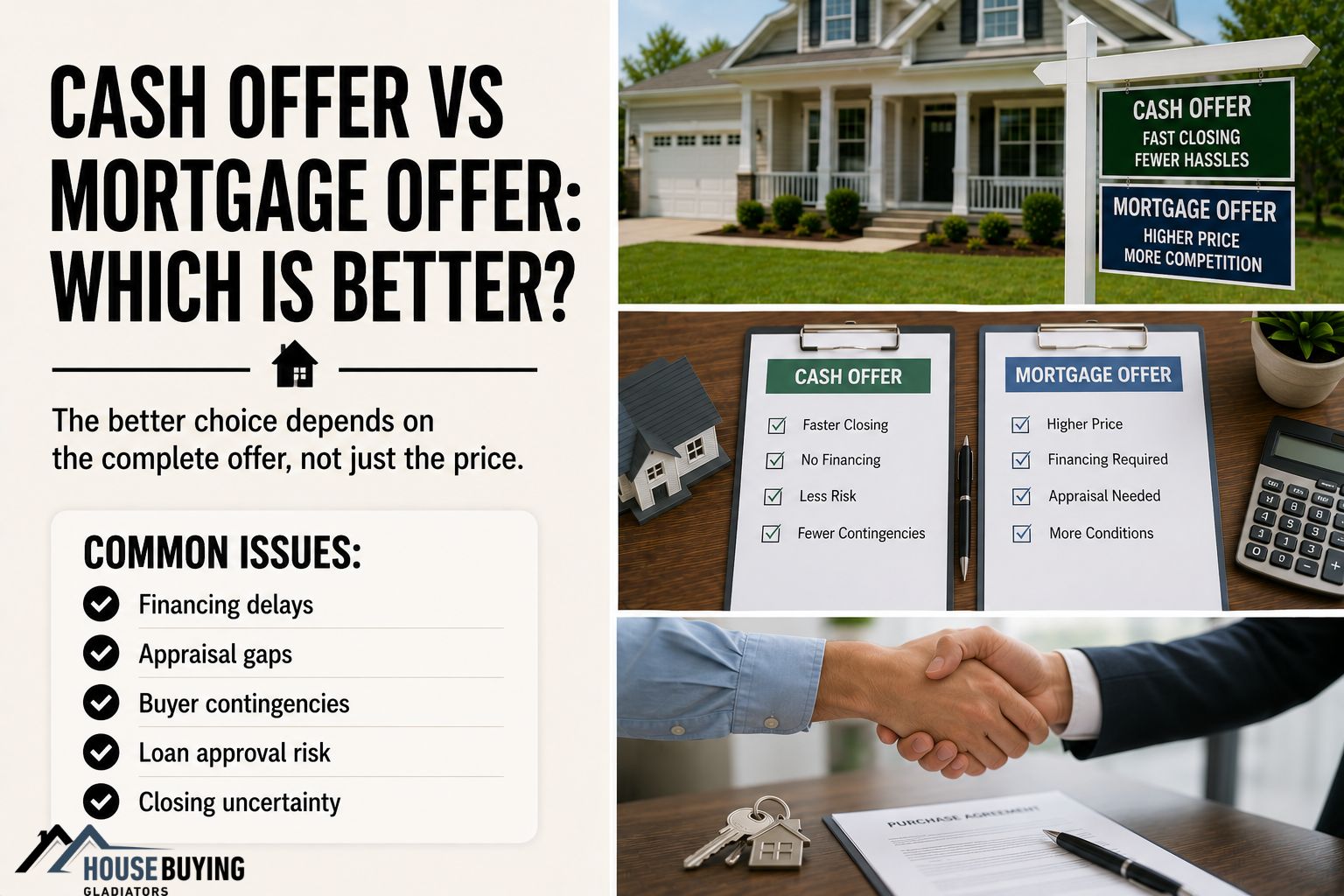
If you’re deciding between a cash offer vs mortgage offer, the short answer is that the better choice depends on the complete offer not just the purchase price. While a cash offer often provides a faster closing and greater certainty, a mortgage offer may deliver a higher sale price in the right market.
Many homeowners focus on the highest number.
Experienced sellers evaluate the likelihood of reaching the closing table.
Financing approval, appraisal requirements, contingencies, closing timelines, and the buyer’s financial strength all influence whether a transaction closes smoothly or falls through. Looking at these factors together helps you choose the offer that delivers the best overall outcome.
Whether you’re selling traditionally or considering a cash sale, understanding cash offer vs mortgage offer helps you reduce risk, compare buyers with confidence, and make a decision that supports your financial goals and timeline.
This guide compares cash offer vs mortgage offer, explains the key differences, outlines the advantages and trade-offs of each option, and shows sellers how to evaluate competing offers before accepting one.
Net Proceeds Comparison Calculator
Net Proceeds Comparison Calculator
Weigh the financial speed and safety of a cash bid against a standard mortgage offer.
Loading real-time financial tracking analysis…
Why Do Cash Offers And Mortgage Offers Differ?
The main difference between a cash offer and a mortgage offer is how the purchase is financed. A cash buyer pays with available funds, while a financed buyer must obtain mortgage approval before the sale can close.
Because cash sales do not rely on a lender, they often close faster, involve fewer contingencies, and carry less financing risk. Mortgage offers, however, may be more competitive on price because buyers can borrow funds to purchase the home.
Offer Received ➔ Financing Reviewed ➔ Terms Compared ➔ Best Offer Selected
| Cash Offer | Mortgage Offer |
|---|---|
| No mortgage financing | Requires lender approval |
| Often faster closing | Closing depends on loan approval |
| Usually fewer contingencies | May include financing and appraisal contingencies |
| Greater closing certainty | Higher financing risk |
When comparing a cash offer vs. mortgage offer, look beyond the purchase price. Financing strength, contingencies, appraisal requirements, and the likelihood of closing all affect the overall value of an offer. Reviewing the differences between cash and mortgage home purchases can help sellers better understand how financing affects closing timelines, negotiation leverage, and transaction certainty before making a decision.
If you’re deciding whether a cash offer is the right fit, should you sell your house to a cash buyer explains when accepting a cash offer may be the better option.
What Are The Benefits Of Accepting A Cash Offer?
Accepting a cash offer can make selling your house faster, simpler, and more predictable because the transaction does not rely on mortgage financing. With fewer lender requirements and fewer contingencies, cash sales often provide greater certainty from offer acceptance to closing.
For many homeowners, the biggest advantage isn’t just speed it’s knowing the sale is less likely to be delayed by financing issues.
Cash Offer Accepted ➔ Minimal Contingencies ➔ Faster Closing ➔ Funds Received
| Benefit | Why It Matters |
|---|---|
| Faster closing | Helps sellers move on a shorter timeline |
| No mortgage financing | Eliminates most lender-related delays |
| Fewer contingencies | Creates a simpler transaction |
| Greater closing certainty | Reduces the risk of a failed sale |
A cash offer can be especially beneficial if you’re relocating, selling an inherited property, avoiding foreclosure, or selling a home that needs repairs. While convenience is a major advantage, always compare the purchase price, contract terms, and closing timeline before accepting an offer. The strongest offer is the one that provides the best overall value not simply the fastest closing.
If you’re considering selling for cash, how does selling a house for cash work explains what sellers can expect from the initial offer through closing.
What Are The Benefits Of Accepting A Mortgage Offer?
Accepting a mortgage offer may help you maximize your sale price because financed buyers often have larger purchasing budgets than cash buyers. In competitive markets, this can lead to stronger offers and greater competition for your home.
Although a financed sale involves additional lender requirements, it may provide the highest overall financial return for sellers who are not working against a tight timeline.
Mortgage Offer Received ➔ Loan Approved ➔ Closing Requirements Completed ➔ Sale Closed
| Benefit | Why It Matters |
|---|---|
| Potentially higher purchase price | May increase your net proceeds |
| Larger buyer pool | Creates more competition for your home |
| Greater negotiating flexibility | Buyers may improve their terms to remain competitive |
| Strong market demand | Can result in multiple offers |
A higher purchase price doesn’t always mean a better offer. Review the buyer’s financing strength, appraisal requirements, contingencies, and expected closing timeline before making your decision. The best mortgage offer is one that combines a competitive price with a strong likelihood of reaching closing.
If you’re comparing competing buyers, how do multiple offers work when selling a house explains how to evaluate offers based on price, financing, contingencies, and closing certainty.
Which Offer Should Sellers Choose?
The best offer is the one that best matches your financial goals, timeline, and level of risk. While a cash offer often provides greater certainty and a faster closing, a strong mortgage offer may deliver a higher purchase price and increase your overall proceeds.
Choosing the right offer means looking beyond the highest number. Consider how likely the buyer is to reach closing, not just how much they are offering.
Compare Offers ➔ Review Terms ➔ Evaluate Risk ➔ Choose The Best Offer
| Seller Priority | Offer That May Be Best |
|---|---|
| Fast closing | Cash offer |
| Fewer contingencies | Cash offer |
| Highest purchase price | Mortgage offer |
| Greater closing certainty | Cash offer |
| Maximum buyer competition | Mortgage offer |
There is no one-size-fits-all answer when comparing a cash offer vs. mortgage offer. Reviewing how to decide on the best offer for your house can help sellers compare purchase price, financing strength, contingencies, closing timelines, and overall closing certainty before making a final decision.
If you’re evaluating your home’s value before comparing offers, what is fair market value of a home explains how market value helps sellers determine whether an offer is truly competitive.
How Can Sellers Compare Cash Offers And Mortgage Offers?
Sellers should compare the entire offer not just the purchase price. Financing strength, contingencies, appraisal requirements, closing timelines, and the buyer’s ability to complete the purchase all determine which offer provides the greatest overall value.
The strongest offer is the one that best balances price, certainty, and the likelihood of a successful closing.
Review Offers ➔ Compare Terms ➔ Evaluate Risk ➔ Choose The Best Offer
| Factor To Compare | Why It Matters |
|---|---|
| Purchase price | Determines your expected proceeds |
| Financing strength | Affects the likelihood of closing |
| Contingencies | May delay or complicate the transaction |
| Closing timeline | Should align with your moving plans |
| Appraisal requirements | May affect the final sale price |
When comparing a offer, look beyond the highest bid. A slightly lower cash offer may provide greater certainty, while a higher mortgage offer could deliver more profit if the buyer successfully closes. Reviewing every part of the offer helps you make a confident decision and choose the option that best supports your financial goals.
If you’re deciding whether to accept an early offer, should you accept the first offer on your house explains how to evaluate competing offers before making a final decision.
FAQs: Cash Offer Vs Mortgage Offer
Neither option is automatically better. A cash offer typically provides a faster, more predictable closing, while a mortgage offer may result in a higher purchase price. The best choice depends on the overall terms, your timeline, and your financial goals.
Many sellers prefer cash offers because they usually involve fewer contingencies, no mortgage financing, and a lower risk of delays or failed closings.
Yes. A mortgage offer may be the stronger choice if it offers a significantly higher purchase price and comes from a well-qualified buyer with strong financing and minimal contingencies.
Not always. The highest offer is not always the strongest. Review financing, contingencies, appraisal requirements, closing timelines, and the buyer’s ability to complete the purchase before making a decision.
In many cases, yes. Because cash buyers do not rely on mortgage approval, cash offers often have fewer financing obstacles and a greater likelihood of reaching closing.
Not always. Many cash buyers do not need a lender-required appraisal, although some may obtain one to help determine the property’s value before completing the purchase.
Compare financing strength, contingencies, appraisal requirements, proof of funds, closing timelines, and the buyer’s overall ability to complete the transaction. These factors often matter just as much as the purchase price.
No. Some cash buyers submit competitive offers based on local market conditions and the property’s value. Others may offer less to account for repairs, investment costs, or resale risk.
Verify proof of funds or financing, review the purchase agreement carefully, compare multiple offers, and evaluate the likelihood of a successful closing before signing a contract.
Conclusion: Cash Offer Vs Mortgage Offer: Which Is Better When Selling A House?
Choosing between a cash offer vs mortgage offer comes down to more than the purchase price. The strongest offer is the one that best matches your financial goals, timeline, and confidence that the sale will close successfully.
Compare Offers ➔ Verify The Buyer ➔ Review The Terms ➔ Close With Confidence
Before accepting an offer, compare financing strength, contingencies, appraisal requirements, and the proposed closing timeline—not just the dollar amount. Taking time to evaluate the complete offer helps reduce risk, avoid unexpected delays, and maximize the value of your home sale.
Ready to choose the right offer? Use this guide to compare cash offer vs mortgage offer, weigh the benefits of each, and make a confident decision that supports a smooth and successful closing.